

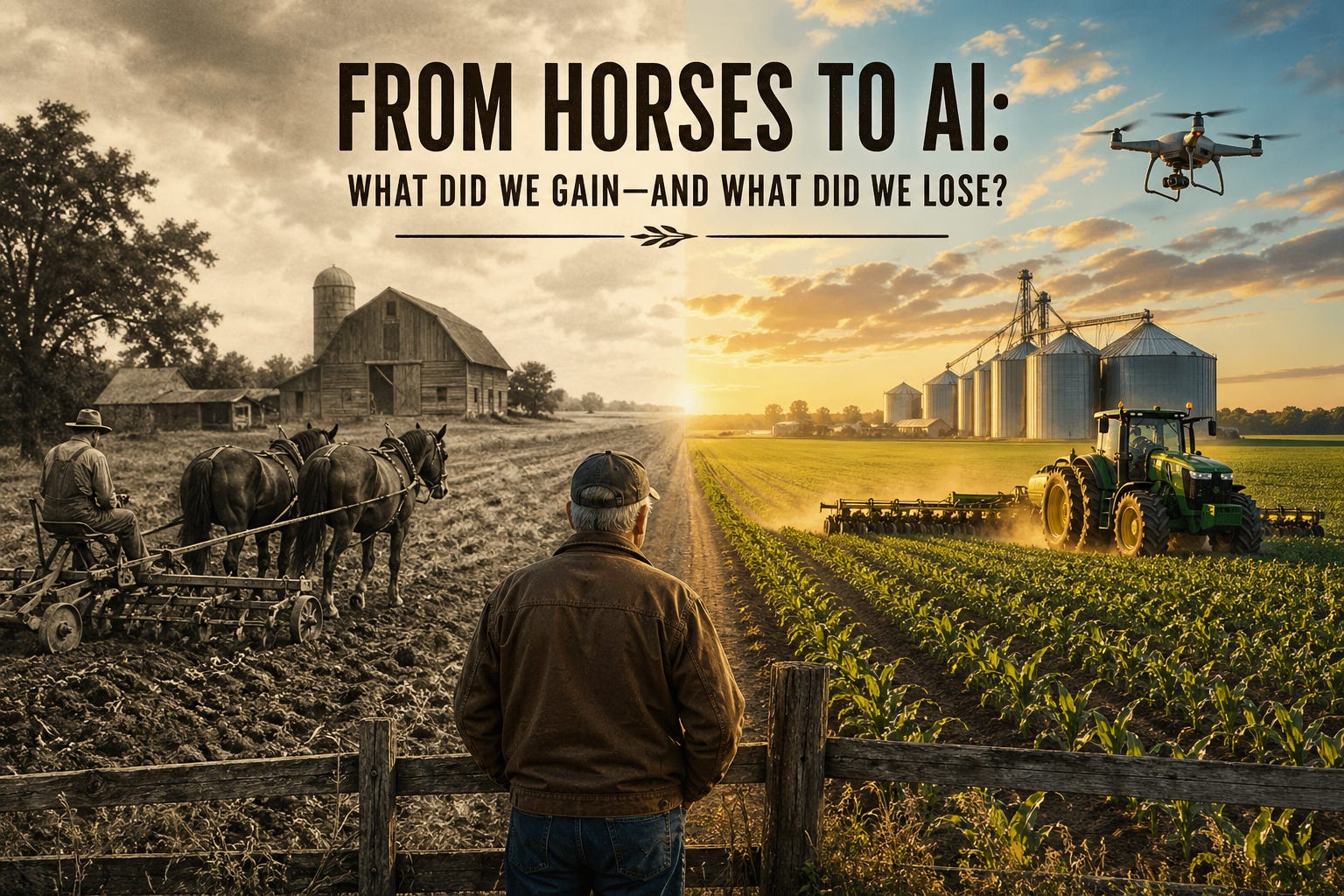
In my 75 years, I’ve seen a lot of change. Shortly before I was born, much of the farming was still done with horses. Today, tractors with several hundred horsepower are common. What once took long days of hard physical labor can now be done in a fraction of the time. Technology is growing at a pace that feels different than anything before it. With the advent of AI, we can now do calculations in seconds that once took hours, days, or even longer. There is no doubt that much of what people do for work will continue to change. Where that ultimately leads, I don’t know. But the question I keep coming back to is this—has any of it made us happier?
We produce more than enough food to feed the world, yet many still go without. The issue is not always supply, but distribution and the ability to afford what is available. Food banks help, but much of what is provided is highly processed, designed more for storage than for health. In solving one problem, we may have quietly created another.
What does it actually take to be happy? It seems we are built to improve things, to fix, to build, to make life easier. I have lived much of my life through projects—always working toward something better. But I’ve noticed something over the years. Once the project is done and life becomes easier, there is often a sense of letdown. Maybe even boredom. It makes me wonder if making life easier was ever really the point. Perhaps it was the effort, the purpose, and the engagement along the way that mattered more.
A simple life might be closer to the answer than we think. A garden in the backyard. Children getting dirt on their hands. Learning how food is grown, not just bought. There was a time when families worked side by side, not because it was ideal, but because it was necessary. In that necessity, something else was built—connection, responsibility, and a shared sense of purpose. Today, much of that has been handed off to systems and institutions. Schools do what they can, but they don’t replace the quiet lessons learned by working alongside a parent.
I still remember working with my dad. My brother and I were young, but we wanted to help. When he came back from the mill with feed, we would try to pull the bags toward the edge of the truck so he could carry them into the barn. It wasn’t much, but to us it meant something. We felt part of it. Looking back, those moments carried more value than we probably realized at the time.
We have seen the family farm largely replaced by large-scale production. In many ways, it is more efficient. But it also changed how we live and how we relate to one another. Now we are starting to see some people move back in the other direction—toward homesteading, growing their own food, and spending more time together as a family. It may not look the same as it once did, but the desire behind it feels familiar.
Somewhere along the way, life became more convenient, but also more disconnected. There was a time when one income could support a family. Over time, that shifted, and now in many households, both parents work just to keep up. That change didn’t just affect finances—it changed the rhythm of family life, often in ways we are still trying to understand.
I don’t claim to have the answers. Progress has brought many good things, and I would not want to give all of them up. But I do think it is worth asking what we may have lost in the process. Not everything that makes life easier makes it better.
Maybe happiness isn’t found in how much we can produce or how efficient we can become. Maybe it’s found in being part of something—working toward something that matters, alongside people who matter.
And maybe the question isn’t how far we’ve come, but whether we’ve stayed connected to what mattered in the first place.
Maybe the things we’re searching for were never ahead of us at all—but behind us, in the way we once lived, worked, and showed up for each other.
Nice. And so true. The doing is oftimes more fulfilling than the project completed