

After leaving Egypt, the Israelites stood on the threshold of freedom. The chains of slavery had been broken, Pharaoh’s power was behind them, the sea had parted, and they had witnessed miracles that few generations could even imagine. You might think that after all of this the next step would be simple: leave Egypt, cross the sea, and enter the Promised Land. But that is not what happened. Instead, they found themselves in the wilderness for forty years.
To many readers, those forty years have seemed primarily like punishment, and certainly the biblical story includes consequences for Israel’s rebellion and refusal to trust. But perhaps there is another layer worth considering. What if the wilderness was not merely a place of punishment, but also a classroom? What if it was not evidence of God’s absence, but a place in which His patient presence could slowly transform a people who had been slaves into people capable of living freely?
Perhaps the same is true in our own lives. There are seasons when we feel lost because old certainties have faded, but new understandings have not yet fully emerged. We no longer belong to the life we left behind, but neither have we arrived at whatever lies ahead. Something has ended, yet whatever is beginning has not taken recognizable form. We find ourselves somewhere in between, and perhaps that in-between place is what the Bible calls the wilderness.
Most of us would prefer a quick transformation. We would like spiritual growth to happen overnight. We have an insight, make a decision, say a prayer, read a book, or experience something profound, and we hope that from that moment onward we will be different. Sometimes awakening really can happen in a moment, but transformation usually takes much longer. God got Israel out of Egypt in a matter of days, but it took much longer to get Egypt out of Israel. Perhaps that is one of the deepest truths hidden within the Exodus story. It is one thing to leave bondage. It is another thing to let bondage leave us.
Imagine what generations of slavery must have done to the Israelites inwardly. Their lives had been controlled by someone else. Fear was familiar, dependence was familiar, and Pharaoh was familiar. Then suddenly they were free. But what does a person who has lived as a slave know about living freely? Perhaps freedom itself had to be learned.
We often think that once the thing controlling us is removed, we will automatically know how to live differently, but perhaps that is rarely true. Someone can leave an unhealthy relationship and still carry the fear created by that relationship for years. Someone can retire from an occupation and discover that inwardly he still measures his worth by how much he accomplishes. Someone can abandon an old belief yet continue reacting emotionally as though that belief were still there. Someone can sincerely forgive another person and later discover resentment unexpectedly returning. The external chains may be gone while the internal ones remain.
That may be why the wilderness matters. The wilderness is where we begin discovering what we carried out of Egypt with us. Fear does not disappear overnight. Neither do pride, resentment, insecurity, jealousy, the need for approval, or the desire to control. Even after moments of profound spiritual insight, we often discover that the same old reactions remain surprisingly close to the surface. We may become discouraged and think, “I thought I had dealt with this.” Perhaps we did, but maybe we have simply reached another layer.
The Israelites repeatedly looked backward toward Egypt. When food became scarce, Egypt suddenly did not seem so terrible. When water became difficult to find, Egypt looked better again. When the journey became uncertain, slavery itself began to acquire a strange attraction. At least in Egypt they knew what tomorrow looked like. How human that is. We can become nostalgic even for things that once imprisoned us simply because they were familiar.
Freedom can be frightening because growth contains uncertainty. The old life may have been limiting, but we understood it. We knew our place within it. The new life requires something different from us. Perhaps this is why the Israelites sometimes wanted to return to Egypt. It was not necessarily because slavery had become good, but because uncertainty had become frightening.
We do much the same thing. We may decide to change something about ourselves and then discover how much easier the old pattern was. We decide not to react in anger anymore, only to find that anger arrives before we have time to think. We decide to stop worrying about what other people think and discover how deeply our need for approval has been woven into us. We decide to surrender some of our need for control, only to discover how quickly it returns when life becomes uncertain. We leave Egypt and then discover that Pharaoh had built an outpost inside us.
Perhaps the wilderness is where those hidden outposts become visible. There are fewer distractions there and less upon which to depend. When familiar supports disappear, things within us that were previously hidden can rise to the surface. That may explain why the Israelites complained so often. It is easy to trust when everything is going well. It is much harder when the water runs out. It is easy to speak of faith when tomorrow seems predictable. It is different when there is no food except what appears each morning.
That makes manna an especially interesting part of the story. The Israelites could not simply gather years of it and create complete security for themselves. They had to receive what was needed for the day. Perhaps the wilderness was teaching them something Egypt never could: trust today, receive what is given today, and walk today. Tomorrow will arrive soon enough.
That sounds simple, but I suspect it is one of the hardest lessons any of us ever learn. Much of our anxiety comes from mentally living in a future that has not yet arrived. We try to solve tomorrow’s problems with today’s information. We imagine possibilities, rehearse outcomes, and convince ourselves that if we think long enough we can somehow guarantee what happens next. But the wilderness does not allow that kind of control. There is only enough manna for today.
Throughout those forty years, God remained with His people. A pillar of cloud guided them by day and a pillar of fire by night. Manna appeared when they were hungry, and water came from unlikely places. They complained, doubted, rebelled, and became frightened, yet the story repeatedly shows God continuing to work with them. Perhaps this is one of the most comforting truths in Scripture: God does not simply wait for us at the end of the journey. He walks with us through it.
Sometimes we imagine the spiritual life as though God waits in the Promised Land while we struggle through the wilderness trying to reach Him. But perhaps God is just as present in the wilderness. When we have plenty, it is easy to believe we are providing for ourselves. When our plans work, we can believe we are directing our own lives. When everything seems secure, we may not pay much attention to the quiet presence guiding us. The wilderness changes that. Suddenly the cloud matters, the fire matters, the manna matters, and the water matters. Perhaps some things become visible only when other things disappear.
That may be one reason wilderness experiences appear so often throughout Scripture. Moses knew the wilderness long before he led Israel through it. David knew the wilderness while fleeing from Saul. Elijah knew the wilderness. John the Baptist emerged from the wilderness. Jesus Himself spent forty days in the desert before beginning His public ministry. Again and again, the wilderness appears near moments of preparation and transformation. Perhaps that should tell us that the wilderness is not necessarily where nothing is happening. It may be where something very important is happening that we cannot yet see.
Think about our own lives. How many times have we looked back at a period that once seemed empty, frustrating, or wasted and discovered that something was actually being formed within us? Perhaps patience was growing, compassion was developing, or an old identity was loosening its grip. Perhaps our certainty was being replaced by humility. Maybe we were learning that we could survive without something we once thought essential, or discovering who we were when familiar labels disappeared.
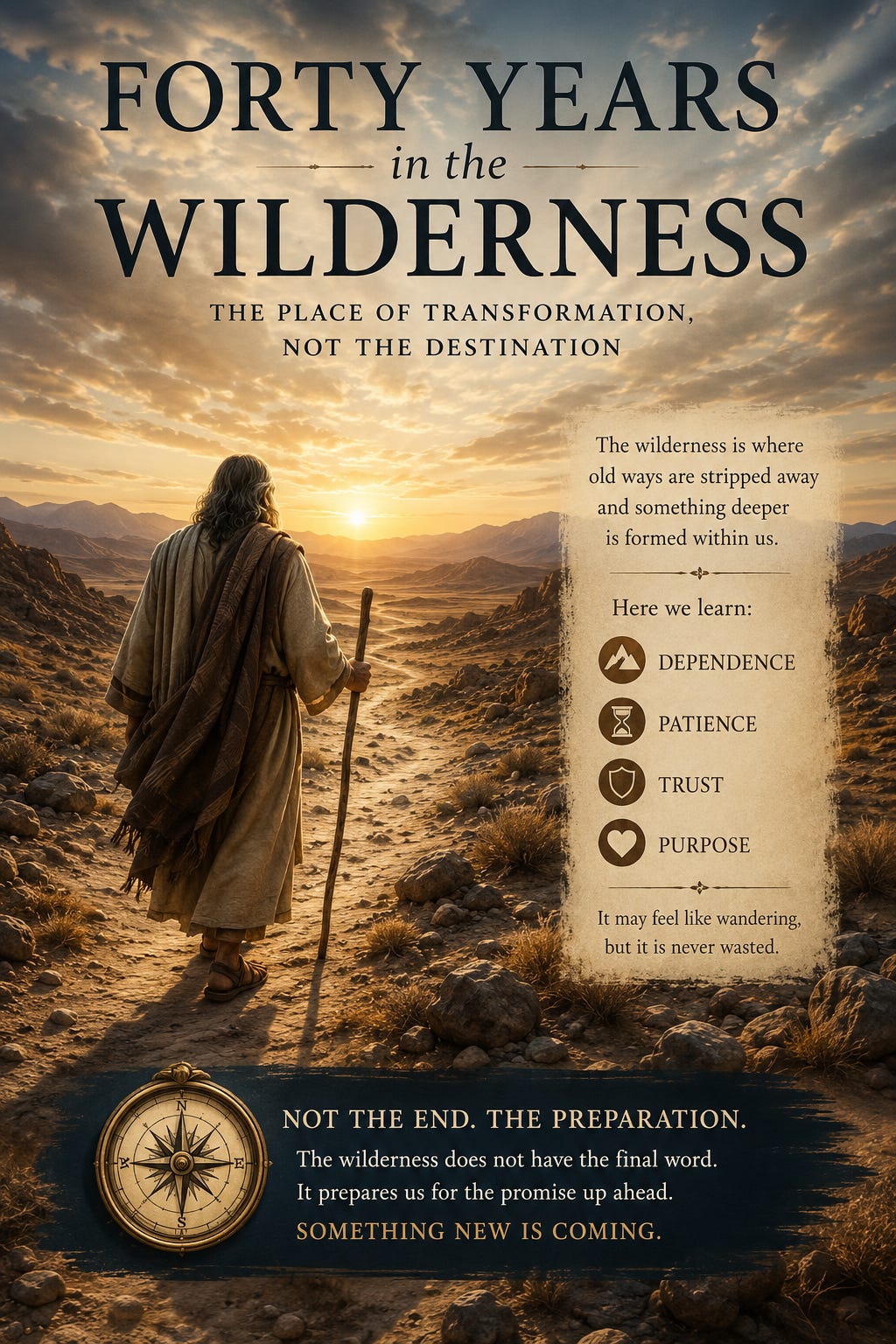
The wilderness strips away illusions and reveals what lies hidden within us. It teaches patience, dependence, humility, and trust. But perhaps most importantly, it teaches us how to live without Pharaoh. Egypt provided a strange kind of security. Pharaoh controlled life, but Pharaoh also made many decisions for them. In freedom, Israel had to develop a different relationship with authority, responsibility, trust, and God. They had to learn how to become a free people rather than merely a population of former slaves.
Perhaps we face something similar inwardly. Once we begin recognizing the false king within ourselves—the ego, the fear, the need to control, the need for approval—we might imagine that seeing it is enough. It isn’t. Recognition is only the beginning. Then comes practice. We begin noticing the reaction before speaking. We catch ourselves exaggerating a story because we want to look better. We notice resentment forming before it becomes bitterness. We recognize the urge to control another person. We see ourselves preparing a reply instead of listening. We discover that part of us wants to be right more than it wants to understand.
That is wilderness work. It may not feel dramatic. No sea parts, no mountain shakes, and no voice comes from the heavens. Sometimes spiritual transformation looks remarkably ordinary. We simply notice what is happening within us and, when we are able, choose differently. Not every time, but perhaps a little more often than before. That may be how slaves gradually become free people.
There is another interesting aspect of the wilderness journey. The generation that left Egypt was not ultimately the generation that entered the Promised Land, apart from Joshua and Caleb. Symbolically, that presents a challenging thought. Perhaps some parts of us cannot enter the next stage of the journey. Certain ways of thinking may have to die in the wilderness. Certain identities may have to be left behind. Certain fears may not be able to accompany us where we are going.
Perhaps this is one reason periods of transition can feel like loss even when they are leading toward something better. Something really is being lost: the person we used to be, the beliefs we once depended upon, the identity we once defended, or the certainty we once needed. The wilderness asks whether we can allow some of these things to fall away without immediately replacing them simply because emptiness makes us uncomfortable.
The Israelites struggled with that too. When Moses remained on Mount Sinai longer than they expected, they built the golden calf. They needed something they could see, something they could control, something that removed the discomfort of uncertainty. Perhaps we create our own golden calves whenever uncertainty becomes so uncomfortable that we grab hold of an easy answer merely to make that discomfort disappear.
Sometimes genuine faith may require us simply to admit, “I don’t know yet.” That can be difficult, especially when we once thought we knew. But perhaps “I don’t know” is not always the opposite of faith. Sometimes it may be the doorway to a deeper faith because it creates room to listen, room to learn, and room for truth to be larger than our present understanding.
Could it be that many of the seasons we call wasted years are not wasted at all? Perhaps some of our greatest growth takes place during periods when outwardly very little seems to be happening. We may feel as though we are wandering, but wandering and being lost are not always the same thing. The Israelites did not know the entire route, but they were not abandoned.
That does not mean every detour in our lives is divinely arranged or that every hardship has been deliberately sent to teach us something. But it does mean that difficult periods do not have to be meaningless. Nothing has to be wasted. That idea has been appearing repeatedly as we move through these biblical stories. Joseph’s prison did not have to be wasted. Jacob’s wrestling did not have to be wasted. Noah’s time inside the ark did not have to be wasted. And Israel’s wilderness did not have to be wasted. Perhaps neither do ours.
There may be periods in our lives when we look around and think, “I should be farther along by now.” Perhaps spiritually we do the same thing. We think we should understand more, react less, have overcome this fear by now, be more patient, or possess stronger faith. But perhaps God is more patient with our journey than we are. Forty years is a long time, yet the cloud remained, the fire remained, and the manna continued. God did not abandon the people because their transformation was taking longer than they expected.
Maybe we should extend some of that patience toward ourselves. The goal is not perfection tomorrow. The goal is movement, awareness, and gradually becoming free. Perhaps the Promised Land is not reached merely by walking enough miles. Perhaps we become capable of entering it by allowing the wilderness to do its work within us.
As we have traveled through these stories, each one seems to leave us with another question. The Garden asked, “Where are you?” Cain asked, “Where is your brother?” Noah asked what remains when the familiar world disappears. Jacob asked what we are willing to wrestle with in order to become someone new. Joseph asked whether we can trust the journey when we cannot yet understand the chapter we are living. Egypt asked what within us is still holding us captive. And now the wilderness asks another question: What still needs to change within me before I can live as a truly free person?
Perhaps that is why the journey from Egypt to the Promised Land takes so much longer than expected. Leaving the prison is only the beginning. Then we have to learn how not to rebuild it inside ourselves.
Perhaps some of us are in the wilderness right now. Something behind us has ended, but whatever comes next has not fully appeared. We may feel uncertain, impatient, or even lost. But maybe nothing has gone wrong. Maybe we are simply somewhere between Egypt and the Promised Land.
The cloud is still there. The fire is still there. There is manna enough for today.
So perhaps for today, that is enough.
We keep walking.
And the journey home goes on.
Coming Next
Joshua and the Promised Land: Entering a New Way of Being
The wilderness was never meant to be the destination. It was a place of preparation. In our next article, we’ll discover what it means to cross the Jordan River and enter the Promised Land—not simply as a place on a map, but as a symbol of living the truths we have come to understand.
40 years, roughly one generation to cast off the idea of enslavement. Much to ponder there as to the thought processes of individuals and the effect on the group as a whole, and becoming whole as an individual.