

For thousands of years, the story of Israel’s bondage in Egypt has been understood as the account of an oppressed people crying out for deliverance. Under the rule of Pharaoh, they endured hardship and slavery until Moses arose and led them toward freedom. It is one of the great liberation stories of Scripture and has inspired oppressed people throughout history.
But what if this story is about more than a nation and a ruler who lived long ago? What if Egypt and Pharaoh also represent something that each of us must eventually confront within ourselves?
We often hear people say that the Bible is a manual for living. But if that is true, do we actually treat it that way? Or do we sometimes read it primarily as bygone history—stories about people who lived thousands of years ago, in places far removed from our own lives?
If Scripture really is meant to help us live, perhaps we should occasionally ask a different question when we read it. Instead of only asking, “What happened to them?” perhaps we should also ask, “Where is this happening in me?”
Where is my Egypt?
Who is my Pharaoh?
What holds me captive?
And what would it actually mean for me to become free?
Egypt itself presents an interesting symbol. In the biblical story, it is not always portrayed negatively. Earlier, Egypt became the place where Joseph rose to power and where his family found food during famine. What once provided refuge eventually became a place of bondage.
Perhaps there is something important in that.
Things that serve us during one period of life can sometimes imprison us during another.
A belief may once have given us security but later prevent us from asking necessary questions. An identity may once have helped us understand ourselves but eventually become something we are afraid to outgrow. A habit may begin as a way of coping with difficulty and gradually become something we cannot imagine living without. Success itself can become an Egypt if maintaining it begins controlling our lives.
Even the desire for security can become a prison.
Perhaps Egypt represents all those places in which we have become comfortable enough to remain but not free enough to grow.
That may be one of the most difficult forms of bondage to recognize because not every prison looks unpleasant from the inside. Some prisons are familiar. Some provide predictability. Some even provide a certain kind of comfort.
We know how things work there.
Freedom, on the other hand, contains uncertainty.
Perhaps that is why people sometimes remain in situations, patterns, relationships, beliefs, or ways of thinking long after they recognize that something is no longer right. What is familiar can feel safer than what is unknown.
Egypt may therefore represent our attachment to fear, our dependence upon approval, our need for control, or the countless habits and beliefs that prevent us from experiencing the freedom of the Spirit. It may even represent identities we have carefully constructed over the years and become afraid to release.
And then there is Pharaoh.
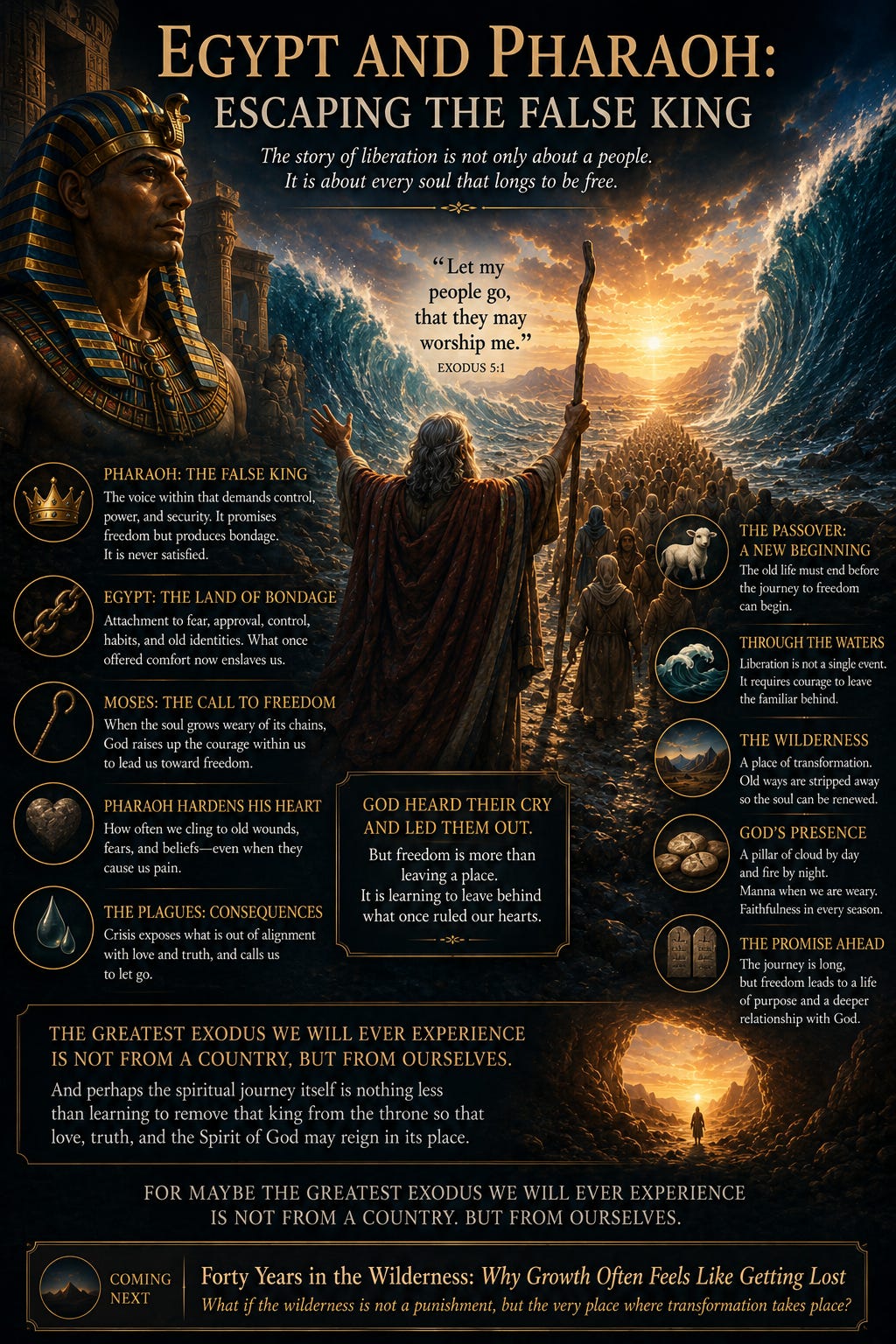
Traditionally, Pharaoh is the ruler who holds God’s people captive. But if we bring the story inward, perhaps Pharaoh also represents the false king residing within each of us—the voice that insists upon being in control, seeks recognition and certainty, protects its position, and resists anything that threatens its authority.
Perhaps Pharaoh is another name for the ego.
Not ego merely in the sense of someone being boastful or arrogant. I mean something more subtle: that constructed sense of “me” that continually tries to manage life, protect itself, defend its image, and control how it is seen by others.
We can find Pharaoh operating in surprisingly ordinary situations.
Suppose we meet someone we haven’t seen in years. Perhaps it is an old acquaintance rather than one of those close friends with whom we can share almost anything. The conversation turns toward what we have been doing with our lives.
How do we tell the story?
Do we tell it exactly as it was?
Or do we polish it a little?
Perhaps we emphasize the successes and quietly leave out some of the failures. We talk about the difficult decision we made but don’t mention how frightened we were while making it. We describe how we handled a challenging situation but leave out the nights when we weren’t nearly as confident as we now make ourselves sound.
Maybe we don’t exactly lie.
We just edit.
Why?
Perhaps the Pharaoh within us wants to control the story.
It wants the other person to see someone who had things reasonably well figured out. Someone competent. Someone emotionally strong. Someone who remained in control.
But was that always the truth?
I can look backward at my own life and recognize times when I probably wasn’t nearly as emotionally strong or certain as I might prefer to remember myself today. There were struggles. There were fears. There were questions. There were times when I did not know what I was going to do next.
Why should that be embarrassing?
Perhaps admitting it is actually closer to freedom.
The false king wants us to maintain the image.
The deeper self simply wants the truth.
That may be one of the most subtle forms of slavery: becoming captive to the person we think we need to appear to be.
Pharaoh does not want the Israelites free because their labor supports his kingdom. Perhaps the false king within us operates similarly. It needs certain things from us in order to maintain itself. It needs comparison. It needs recognition. It needs defensiveness. It needs to be right. It needs someone else to be wrong. It needs us continually thinking about ourselves.
And isn’t it interesting that this false king always promises freedom while producing bondage?
It tells us that if we acquire enough, accomplish enough, know enough, receive enough approval, or gain enough control, we will finally be secure.
But enough never arrives.
There is always something more to acquire, another person to impress, another argument to win, another threat to our identity, another uncertainty to eliminate.
Like Pharaoh, the false king is never satisfied.
Meanwhile, something deeper within us begins to grow weary.
The story tells us that God hears the cries of His people.
Perhaps there comes a time in every life when the soul begins crying out as well. Something within us recognizes that the way we have been living is no longer enough. We may not yet know what freedom looks like, but we begin knowing that bondage is no longer acceptable.
Maybe this is where Moses appears symbolically.
Moses may represent that awakening voice within us that finally becomes willing to stand before Pharaoh and speak the words the false king does not want to hear:
“Let my people go.”
Let go of the fear.
Let go of the need for approval.
Let go of the resentment.
Let go of the identity you have spent decades protecting.
Let go of the need to control everything.
Let go of the belief that you must always appear strong.
Let go.
But Pharaoh refuses.
Again and again Moses comes before him with the same demand, and again and again Pharaoh’s heart hardens.
How familiar that struggle can be.
We may clearly see something within ourselves that needs to change and still resist changing it. We can know that resentment is hurting us and continue carrying it. We can know that fear is limiting our lives and still obey it. We can recognize an unhealthy habit and continue repeating it. We can realize that a belief no longer makes sense to us and remain afraid to examine it honestly.
Part of us wants freedom.
Another part wants familiarity.
Perhaps that is one of the central struggles of the spiritual journey.
We may pray for change and then resist the very circumstances through which change becomes possible.
We say, “God, make me more patient,” and then become irritated when life gives us opportunities to practice patience.
We ask for courage but would prefer never to encounter anything frightening.
We ask for wisdom but don’t want to make mistakes.
We ask for deeper truth but become uncomfortable when truth challenges something we already believe.
We ask to leave Egypt but still want Egypt to remain available in case the wilderness becomes difficult.
Perhaps the plagues can also be considered symbolically. In the biblical story they become escalating judgments upon Egypt and its gods as Pharaoh repeatedly refuses to release the Israelites. But inwardly, perhaps they can remind us of what sometimes happens when we continually refuse to confront something that needs to change.
Life has a way of making certain lessons increasingly difficult to ignore.
A small warning appears.
We dismiss it.
The problem grows.
We rationalize it.
Something begins affecting our relationships, health, peace, or ability to live freely.
Still we resist.
Sometimes the crisis becomes severe enough that we can no longer pretend nothing needs to change.
This doesn’t mean every illness, loss, tragedy, or hardship is a punishment from God. That would be far too simple and often terribly unfair. But difficult circumstances can reveal things within us that comfortable circumstances allow us to ignore.
Sometimes the question is not, “Why is God doing this to me?”
Perhaps it is, “What is this experience showing me about myself?”
What am I clinging to?
What am I afraid to release?
Where is Pharaoh still saying no?
Then comes the Passover, one of the great turning points in the biblical story. The old life is ending. The Israelites are preparing to leave the world they have known for generations. They do not yet know what lies ahead.
That must have required tremendous courage.
We sometimes imagine freedom as though chains simply fall away and everyone immediately celebrates. But genuine freedom can be frightening because bondage, however painful, is at least familiar.
The Israelites knew Egypt.
They did not know the wilderness.
Perhaps we experience the same thing whenever an old identity begins falling away. Who am I if I am no longer this occupation? Who am I if I stop needing this person’s approval? Who am I if I release this resentment that I have carried for twenty years? Who am I if I admit that something I once believed with certainty may need to be reconsidered?
The prison may be uncomfortable.
But at least we know who we are inside it.
Freedom asks us to discover something new.
Then Israel reaches the Red Sea.
Pharaoh is behind them.
Water is in front of them.
There appears to be no way forward and no safe way backward.
Perhaps many major transformations eventually bring us to such a place.
The old life no longer works.
The new life has not yet opened.
We stand between them.
And then a path appears where no path seemed possible.
The people pass through the waters.
Perhaps that is another kind of baptism—the crossing from one identity into another. Egypt remains behind. Something has ended.
But the story is far from finished.
Because leaving Egypt turns out to be easier than getting Egypt out of the Israelites.
That may be one of the deepest truths in the entire Exodus story.
The people are physically free, but inwardly they still carry the habits of slavery.
When food becomes scarce, they remember Egypt.
When water becomes scarce, they remember Egypt.
When Moses remains too long on the mountain, they become afraid and construct the golden calf.
Again and again, when freedom becomes uncomfortable, they look backward.
We do the same thing.
We can make a genuine change and still carry our old patterns with us. We can forgive someone and later feel resentment returning. We can recognize the need to release control and then find ourselves grasping for it again the moment uncertainty appears. We can experience a spiritual awakening and still wake up the next morning with the same personality we had yesterday.
Liberation is not a single event.
It is a process.
Perhaps that is why there is a wilderness between Egypt and the Promised Land.
The wilderness is where freedom has to become internal.
It is where people who have been told what to do must learn how to trust. It is where old identities begin dying and new ones have not yet fully formed. It is where there are fewer distractions and therefore fewer places to hide from ourselves.
The wilderness can feel empty.
But emptiness is sometimes where we finally hear.
Throughout that journey, God remains present. A pillar of cloud leads by day and fire by night. Manna appears when food is needed. Water comes from unexpected places. The people complain, doubt, rebel, and become frightened, yet God continues working with them.
That may be encouraging for anyone attempting genuine inner change.
We are not expected to get everything right the moment we leave Egypt.
We will stumble.
Old reactions will return.
The false king may attempt to climb back onto the throne.
We may discover parts of ourselves that we did not know were still enslaved.
But the journey continues.
Perhaps the Exodus is therefore not merely the story of escaping a geographical place called Egypt. It can also become a picture of the great inner movement from bondage toward freedom.
And perhaps Pharaoh is one of the clearest biblical pictures of the false king we have been looking for throughout this entire journey.
The king who says:
I must control.
I must be recognized.
I must be right.
I must protect myself.
I must maintain the image.
I must remain on the throne.
And then somewhere deeper comes another voice:
“Let my people go.”
Perhaps that voice is the beginning of awakening.
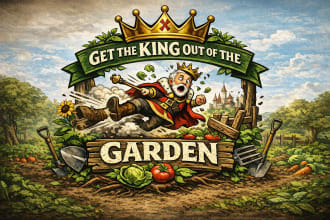
The title Get the King Out of the Garden grew from the idea that something within us has taken a throne that was never meant to belong to it. The Exodus story gives us another picture of that same struggle. Pharaoh rules by fear and control. He refuses surrender. He would rather see his kingdom suffer than relinquish his authority.
Perhaps our own false king can be just as stubborn.
But the destination of the spiritual journey is not simply the destruction of Pharaoh. It is freedom from his rule.
There is an important difference.
We do not need to hate ourselves in order to become free of the ego. We do not need to destroy our personality or eliminate every human desire. We simply need to recognize what has been ruling us unconsciously and gradually place it under something higher—truth, conscience, love, humility, awareness, and ultimately the Spirit of God.
Perhaps that is what it means to put the proper King back upon the throne.
The Garden asked us, “Where are you?”
Cain asked, “Where is your brother?”
Noah asked what remains when the familiar world disappears.
Jacob asked what we are willing to wrestle with in order to become someone new.
Joseph asked whether we can trust the journey when we cannot yet understand the chapter we are living.
And now Moses and Pharaoh bring us face-to-face with another question:
What within me is still holding me captive?
Perhaps that is one of the most important questions we can ever ask.
Because the greatest Egypt we will ever leave may not be a country.
The most stubborn Pharaoh we will ever confront may not sit upon a throne.
And the greatest exodus of our lives may be the journey out of the fears, identities, habits, and illusions that have quietly ruled us for years.
Maybe freedom begins the moment we finally recognize the false king.
Then comes the harder part.
We have to leave Egypt.
We have to cross the water.
We have to walk through the wilderness.
And we have to keep going even when part of us wants to turn around.
Because perhaps the Promised Land is not simply somewhere we arrive.
Perhaps it is something we gradually become capable of entering.
And the journey home goes on.
Coming Next
Forty Years in the Wilderness: Why Growth Often Feels Like Getting Lost
What if the wilderness was never a punishment, but a classroom?
What if God got Israel out of Egypt in days, but it took forty years to get Egypt out of Israel?
And what if transformation in our own lives works much the same way?
"The ability to have a new thought is a profound gift" Master Lama Rasaji. It is what miracles are made of.