


If you are joining us here you may wish to start at chapter 1 or go back to chapter 8.
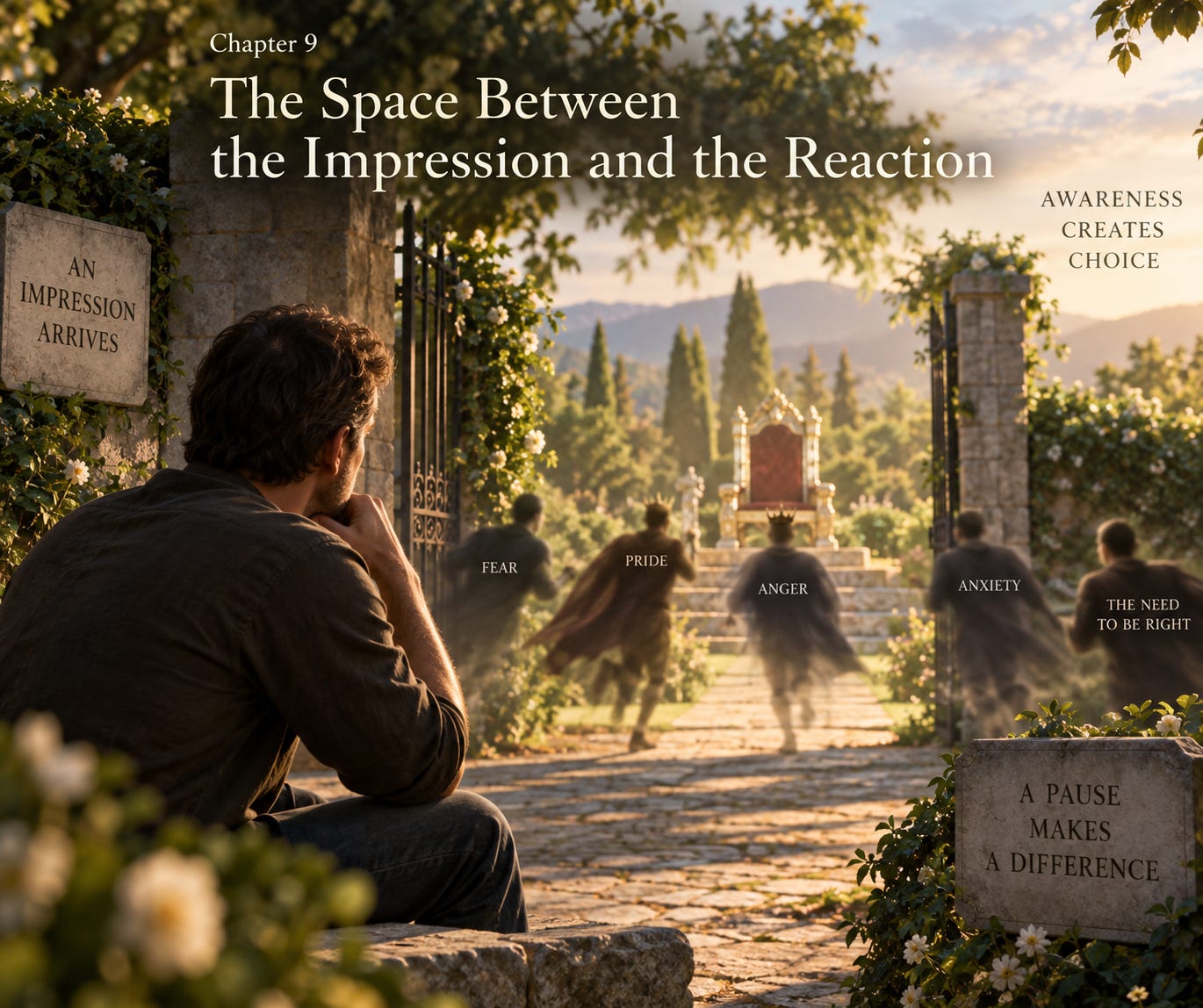
Most of us probably believe we make far more conscious decisions than we actually do. Something happens, someone says something, a memory surfaces, a problem appears, and almost instantly we respond. We become irritated, defensive, excited, frightened, offended, or determined. Because the response comes from within us, it feels as though we consciously decided how to respond. But when we begin watching ourselves more carefully, something rather remarkable appears. Much of the response was already underway before we consciously chose anything. An impression entered the Garden, and one of its inhabitants immediately began moving toward the throne.
This is one of the most useful discoveries we can make through self-observation. Between what happens to us and what we eventually do with it lies a territory we rarely notice. At first that territory may seem almost nonexistent. Someone criticizes us and irritation appears. Someone challenges something we believe, and an argument begins forming in our mind. We hear frightening news and anxiety rises in the body. The impression and the reaction seem to be one event, but they are not. Somewhere between them is a space. At first that space may last only a fraction of a second, yet as awareness grows, it can become larger. Within that small opening, something new becomes possible: choice.
Imagine someone saying something you believe is completely wrong. Perhaps they are talking about politics, religion, family, or something else you care deeply about. Before they have even finished speaking, another part of you may already be preparing the answer. The body can join in as well. The abdomen tightens, the shoulders rise, the heart beats a little faster, thoughts begin lining up arguments, and an emotional reaction starts gathering strength. One part wants to correct the person. Another may want to prove that you are right. None of these movements are necessarily bad. They are simply parts of our human machinery doing what they have learned to do.
The problem begins when one of them becomes king. If irritation takes the throne, irritation speaks. If pride takes the throne, pride speaks. If fear takes the throne, fear speaks. If the need to be right takes the throne, it may begin gathering evidence before the other person has even finished talking. Ordinarily, we experience all of these reactions simply as me. Self-observation introduces another possibility. Instead of immediately asking, What should I say? we can quietly ask, What is happening inside me right now? That small change of attention can alter the entire situation.
One of the practices I have increasingly found useful is simply allowing an impression to arrive before deciding what to do with it. That sounds easy, but our machinery is remarkably fast. Someone says something and the emotional center responds. The intellectual center begins constructing an argument. The instinctive center may sense danger or discomfort. The moving center may already be changing our posture or preparing us to speak. The whole inner government can mobilize within seconds. Yet awareness can begin to notice that mobilization. There may be a sensation in the abdomen, tension in the shoulders, a sudden emotional charge, or simply a thought saying, I need to answer this. When we notice it, another possibility appears: maybe I don’t have to answer immediately. I can receive the impression first.
I have found this especially interesting when listening to podcasts, news programs, interviews, or discussions where people express opinions very different from my own. These situations can become a kind of practice laboratory. An opinion enters, something inside reacts, and instead of immediately following the reaction, I can watch it. Sometimes I can almost feel the response forming before the words would come out. At other times the reaction is more physical, perhaps a sensation in the abdomen or a subtle tightening somewhere in the body. The interesting part is no longer merely whether the other person is right or wrong. The more revealing question becomes: What is happening inside me because I heard it?
That changes the entire exercise. The other person is no longer simply someone whose opinion I must accept, reject, or defeat. Without knowing it, that person has given me an opportunity to see my own machinery. Friction becomes information. A disagreement that once would have been entirely about the other person can become a mirror showing me something about myself.
There is an important distinction here. Observing a reaction does not mean suppressing it. If anger appears, pretending we are not angry is not consciousness. If fear appears, pushing it down does not make us free from fear. If we disagree with someone, remaining silent is not automatically wisdom. The purpose of the pause is not to become passive. The purpose is to become less mechanical. There are times when we should speak strongly, times when boundaries need to be established, times when injustice should be challenged, and times when leaving a situation may be wiser than remaining in it. But there is a tremendous difference between consciously choosing an action and being pushed into it by whichever part of us happens to seize the throne.
This brings us back to one of the most practical questions in this entire journey: Which part of me is answering? Is it fear, pride, compassion, embarrassment, the need for approval, the need to win, a wounded memory, or simply habit? Or is there something quieter underneath all of these? Sometimes merely asking the question loosens our identification with the reaction. Instead of saying, I am angry, we begin to notice, Anger is present. Instead of thinking, I have to defend myself, we notice, Something in me feels the need to defend itself. That may appear to be only a small change in language, but inwardly it represents something much larger. We have moved a few inches away from the throne, and from those few inches we can begin to see who is sitting there.
I once thought spiritual growth should eventually eliminate many of these reactions. I am no longer convinced that is the best way to measure progress. Perhaps the more meaningful measure is how quickly we remember ourselves after a reaction begins. At first we may become angry and remember hours later. Later we remember after twenty minutes. Eventually it may be thirty seconds. Then one day we catch the reaction while it is actually forming. The reaction may still arise, but now someone is watching.
This is why progress in self-observation can be difficult to recognize. We may still experience fear, irritation, pride, anxiety, or defensiveness and conclude that nothing has changed. Yet something may have changed enormously: we are remembering sooner. Reaction becomes awareness, awareness creates a pause, the pause allows discernment, and discernment makes a conscious response possible. Sometimes that response will be speaking. Sometimes it will be acting. Sometimes it will be setting a boundary. And sometimes the most conscious response will be no response at all.
There is another interesting thing we may begin to notice. The lesser kings within us often speak with great urgency. Fear says, Do something. Pride says, Correct them. Anger says, Strike back. Anxiety says, Fix this immediately. The need for approval says, Make them understand you. Yet the deeper center within us seems to have a different quality. It does not always need to shout. It can wait. It can observe. It can receive an impression without immediately becoming that impression.
Perhaps there is an echo here of Jesus’ repeated invitations to watch, listen, and develop eyes to see and ears to hear. There is a quality of attention that comes before action. We normally think freedom means being able to do whatever we want, but perhaps there is a deeper freedom: the freedom not to obey every impulse that arises within us.
During the coming days, we can experiment with something very simple. Watch for one moment when an event, statement, memory, or opinion produces an immediate reaction. Don’t try to stop the reaction, judge it, or even analyze where it came from. Simply notice it. If possible, notice where it appears in the body. Then quietly ask, Which part of me is answering? Can I receive this impression before I respond to it? You may ultimately give exactly the same response you would have given before, and that is perfectly all right. The important difference is that this time you may have been present when the decision was made.
That tiny difference may be one of the beginnings of genuine inner freedom. The Garden will always receive impressions. Thoughts will arise, emotions will move, instinct will protect, memories will speak, and different selves will continue walking through its gates. We do not need to drive them out. Each has its place. What we are learning is not to hand every visitor the crown.
Every time we create even a few seconds between an impression and our response, the throne becomes a little less available to whichever part happens to rush toward it first. Perhaps this is one way the true King gradually returns to the Garden—not through force, but through attention.
Coming Next in chapter 10:
In the next chapter, we will look more closely at identification—what happens when we become so absorbed in a thought, emotion, role, belief, or problem that we temporarily lose our ability to see it. The most powerful king in the Garden may sometimes be the one we don’t realize we have become.
If this series has given you something worth thinking about, consider sharing it with someone who might enjoy exploring these questions with us. Sometimes one thoughtful conversation is enough to help another person begin looking inward.
A Note About This Series: During this series, it may seem that there is some repetition. This is intentional. These ideas are not meant simply to be understood intellectually, but gradually integrated into our everyday awareness. Repetition and reminders can help bring patterns that normally remain beneath conscious awareness into the surface mind, until observation becomes more natural and less something we have to strive to remember. Also, throughout these chapters, references to the lesser “king” or the king attempting to take the throne are generally referring to the ego and our mechanical reactions—not to Christ or the true spiritual King.