


If you are starting here you may wish to go back to chapter 1
In the last chapter, we looked at the Jack, Queen, and King as a way of recognizing different levels of activity within our centers. The purpose was never to turn ourselves into a deck of cards. The cards are only a temporary map—a way to begin recognizing something that normally happens too quickly for us to see. Once we begin seeing it, the map becomes less important. We start noticing the actual movement within ourselves.
And that brings us to perhaps the most important moment in this entire work.
Something happens. We receive an impression. Someone says something we do not like. We hear an opinion that conflicts with our own. A driver pulls out in front of us. Someone criticizes us. An unexpected bill arrives. We read a troubling headline. A family member speaks sharply. Before we realize what has happened, something within us has already begun responding. The body tightens, an emotion rises, thoughts appear, and words begin forming. We may even be speaking before we are consciously aware that a decision has been made.
Most of the time, there seems to be no space between what happens to us and what comes out of us. But there is. Learning to find that space may be one of the beginnings of genuine freedom.
The Impression Comes First
Everything begins with an impression. Something enters our awareness through sight, sound, memory, imagination, sensation, or thought. The impression itself may last only a fraction of a second, but almost immediately our inner machinery begins working on it.
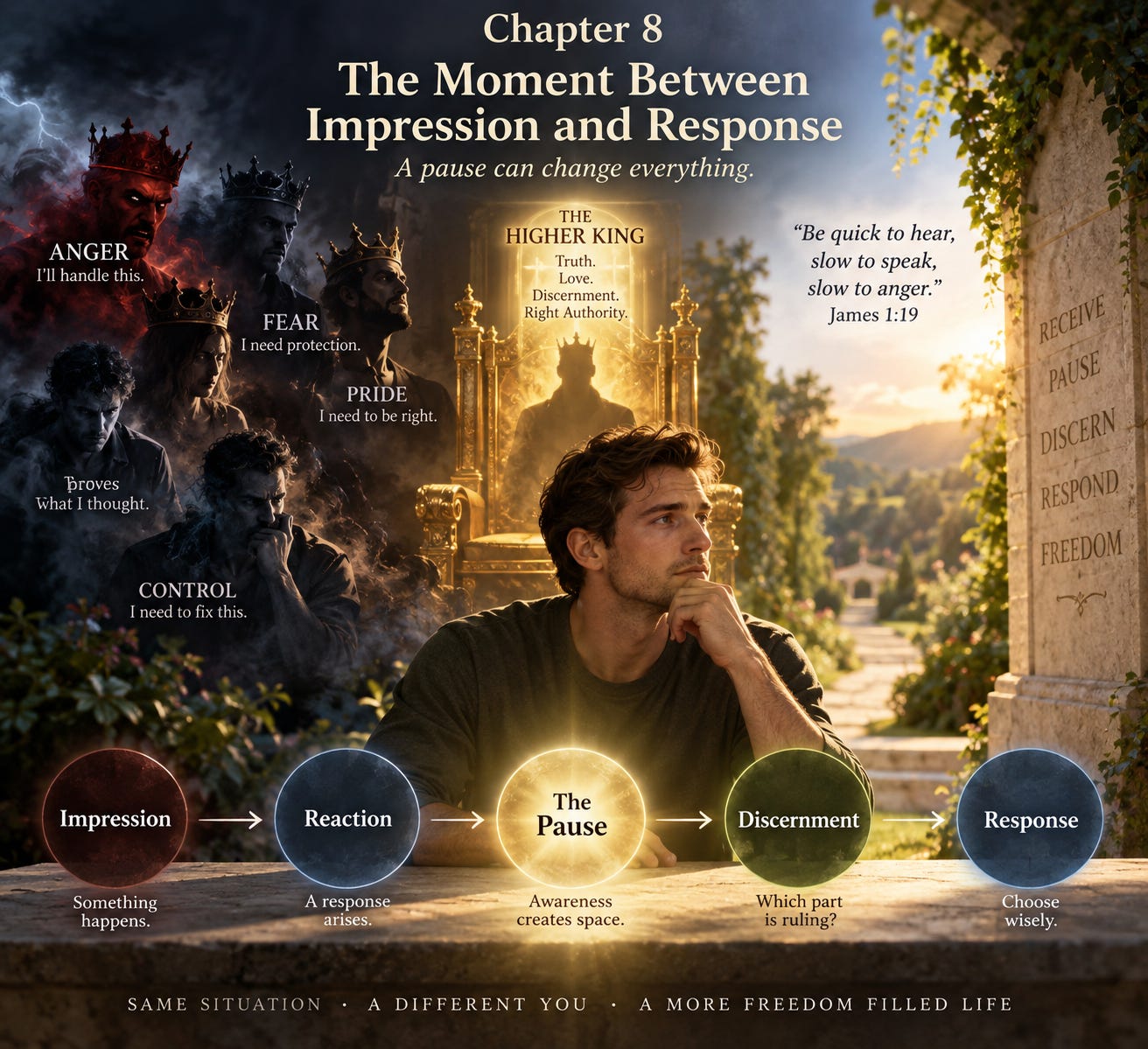
Imagine that someone says, “I think you’re completely wrong about that.” Those are simply words. They enter through the ears as an impression, but they rarely remain merely words. Almost instantly, something inside begins interpreting them. Perhaps the emotional center hears rejection. The intellectual center begins assembling arguments. The instinctive center senses threat. The moving center prepares the body as muscles tighten, posture changes, and perhaps the face hardens. One of our familiar selves steps forward and says, in effect, I’ll handle this.
Before long, we are no longer receiving the impression. We are reacting to our interpretation of it. This can happen so quickly that we experience the whole sequence as one event: He insulted me, so I became angry. Yet when we observe carefully, we begin discovering that several things happened between those two points. There was the impression, followed by an interpretation. The body responded, an emotion arose, thoughts appeared, an impulse to act developed, and finally there was the action. Normally these occur almost as one movement. Self-observation begins to slow the process down enough for us to see its parts.
Reaction Is Fast—Awareness Is Quiet
Mechanical reactions are fast because they have been practiced thousands of times. We do not have to think about them. Someone pushes the right button and the familiar program runs. The need to defend ourselves may appear, or the need to explain, prove that we are right, withdraw, strike back, please someone, worry, or control the situation.
None of these reactions necessarily makes us bad people. Many developed for understandable reasons, and some once served important purposes. The problem begins when they operate without our awareness and automatically occupy the throne.
That is why this work is not primarily about suppressing reactions. If anger rises, pretending we are not angry accomplishes little. If fear arises, condemning ourselves for being afraid merely adds another layer of reaction. The first task is much simpler: see it.
Instead of immediately saying, I am angry, we might begin noticing, Something in me is becoming angry. Instead of I have to defend myself, we might recognize, Something in me wants to defend itself. We might notice fear arising or recognize that something within us needs to be right. The anger, fear, or defensiveness is still real. We are not denying it. But we are no longer completely fused with it.
Someone is watching.
That small change connects directly with the question we have been exploring throughout this series: Which part of me is answering?
The Sacred Pause
Between an impression and our response, there can be a pause. At first it may be extremely small—perhaps no more than one conscious breath—but that breath can change everything.
Someone says something irritating. You feel the tightening in your abdomen or chest. A reply immediately appears in your mind, and normally it would come straight out of your mouth. But this time you notice. You do not immediately suppress the reply, and you do not immediately express it. You simply receive the impression and, for perhaps two seconds, remain present.
Those two seconds may not look very impressive from the outside, but inwardly something remarkable has happened. The mechanical chain has been interrupted. A reaction arose, but it was seen before it became action. This is where choice begins.
The Fourth Way sometimes speaks of remembering oneself. Christian language might describe something similar as becoming watchful, sober, awake, or attentive to what is moving within the heart. Jesus repeatedly called people to watchfulness, and James advised being quick to hear and slow to speak and to anger. These teachings become very practical when we realize how quickly our inner reactions normally seize control.
The pause creates an opening in which another question can appear: Do I want to obey this reaction?
That is very different from asking whether the reaction is justified. The ego can produce a courtroom full of evidence proving why it deserves to react. The better question is whether this particular inner voice should be ruling us at this moment.
The Lesser King Wants Immediate Authority
This brings us back to the image of the garden and the throne. There are many legitimate functions within us. Intellect should think. Emotion should feel. Instinct should protect. The moving center should act. Caution, ambition, confidence, anger, fear, and even the desire to defend ourselves may sometimes have useful roles.
Each king has its place, but every king is not entitled to the throne.
When we react mechanically, one of these lesser kings often grabs authority before we even realize an election has taken place. Fear says, I am in charge now. Anger says, Move aside. Pride says, I’ll answer this. Hurt says, I know exactly what this means. The pause gives us time to notice the takeover and ask: Which king is ruling right now—and is that the king I truly want to serve?
For the purposes of this journey, the higher King points toward that deepest God-oriented center within us where truth, conscience, love, humility, and awareness begin coming together. For Christians, this does not mean replacing Christ on the throne of our being. Quite the opposite. The work is learning to recognize the ego and the mechanical parts that continually attempt to take authority that does not belong to them.
Self-observation does not crown the observer. It exposes the pretenders.
Receiving Before Responding
One of the simplest practices we can begin using is to receive the impression first. This sounds almost ridiculously simple, yet it can be surprisingly difficult.
Can we listen to someone’s entire sentence without preparing our answer? Can we notice an unpleasant emotion without immediately explaining why we are entitled to it? Can we feel tension in the body before trying to remove it? Can we encounter an opposing opinion without instantly deciding what kind of person would believe such a thing? Can we notice fear before constructing a story about what might happen?
For a moment, just receive what has arrived.
This does not mean becoming passive. Sometimes a strong response is exactly what a situation requires. Boundaries may need to be established. An injustice may need to be confronted. A dangerous situation may require immediate action. Conscious living does not mean becoming harmless in the sense of being incapable of decisive action. The difference is that action increasingly comes from discernment rather than compulsion.
There is a tremendous difference between anger using us and consciously using the energy of anger to address something that needs correction. One is possession. The other is stewardship.
The Body Often Knows First
As we practice, we may discover that the body gives us an early warning that a mechanical reaction is forming. The jaw may tighten, the shoulders rise, the stomach contract, breathing change, the heart speed up, heat appear in the face, or the hands tense. These sensations can become valuable signals. Instead of seeing them as inconveniences, we can treat them almost like a bell calling us back to ourselves.
Something is happening in me.
That is the moment to become interested rather than judgmental. Where do I feel it? What emotion is connected with it? What thoughts are appearing? What does this part of me want to do? And perhaps most importantly: Can I allow this impression to exist for a moment without immediately becoming it?
That question begins moving us beyond the playing cards. We no longer necessarily have to think, This is the Queen of Hearts or This is the Jack of Clubs. Eventually we simply recognize the movement directly—fear, defensiveness, pride, hurt, compassion, reason. The map has served its purpose. We are beginning to see the territory.
Freedom Does Not Mean Having No Reactions
We should also be careful about how we measure progress. The goal is not to reach some imaginary state in which nothing ever bothers us. That can easily become another spiritual ego: A truly conscious person would never become irritated. That is not the point.
Progress may simply mean that we remember sooner. At first, we may react and recognize it an hour later. Eventually it may be ten minutes later. Then we notice while we are still reacting. Later we may catch the reaction just before speaking. And occasionally something extraordinary happens: we see the entire movement arise and choose not to follow it.
The external situation may be exactly the same, but something within us has changed. The old self appeared. It simply was not given the keys to the kingdom.
A Simple Practice for This Week
During the coming week, there is no need to attempt this with every moment of the day. Choose ordinary situations. When you notice a reaction beginning, remember this simple movement: Reaction → Awareness → Pause → Discernment → Response.
Notice what is happening in the body, emotion, and mind. Pause, even if only for one breath. Ask which part of you wants to respond. Then choose whether to speak, act, wait, or perhaps do nothing at all.
Do not worry about getting it right. In fact, some of the most useful observations will come when you completely forget the practice and react mechanically. When you remember afterward, look back without condemning yourself. See what happened. What was the first sensation? Which thought followed? Which part grabbed the throne?
Every time we see the mechanism more clearly, we become a little less imprisoned by it. The victory is not perfection. The victory is awakening.
The Doorway to Conscious Living
We began this series by asking how we might move beyond the conditioning and programming that have shaped so much of our lives. The answer is not found merely by acquiring more spiritual information. We can read hundreds of books and still react exactly as we always have.
Transformation begins in moments that seem almost insignificant: a breath before answering, a sensation noticed in the abdomen, an angry thought seen rather than spoken, a judgment recognized before it becomes condemnation, or a moment when we realize, There is that part of me again.
And then comes the quiet question: Does it need to rule?
That tiny space between impression and response may be one of the most important places in the garden, because that is where the throne becomes visible. And once we can see the throne, we can begin becoming much more careful about who we allow to sit upon it.
Coming Next
Chapter 9 — When We Become Identified
We will look at what happens when we become so absorbed in a thought, emotion, opinion, role, or grievance that we can no longer see it objectively—and why recognizing identification may be one of the keys to waking up.
If you are joining us here you may wish to start at chapter 1 or go back to chapter 7.
A Note About This Series: During this series, it may seem that there is some repetition. This is intentional. These ideas are not meant simply to be understood intellectually, but gradually integrated into our everyday awareness. Repetition and reminders can help bring patterns that normally remain beneath conscious awareness into the surface mind, until observation becomes more natural and less something we have to strive to remember. Also, throughout these chapters, references to the lesser “king” or the king attempting to take the throne are generally referring to the ego and our mechanical reactions—not to Christ or the true spiritual King.