


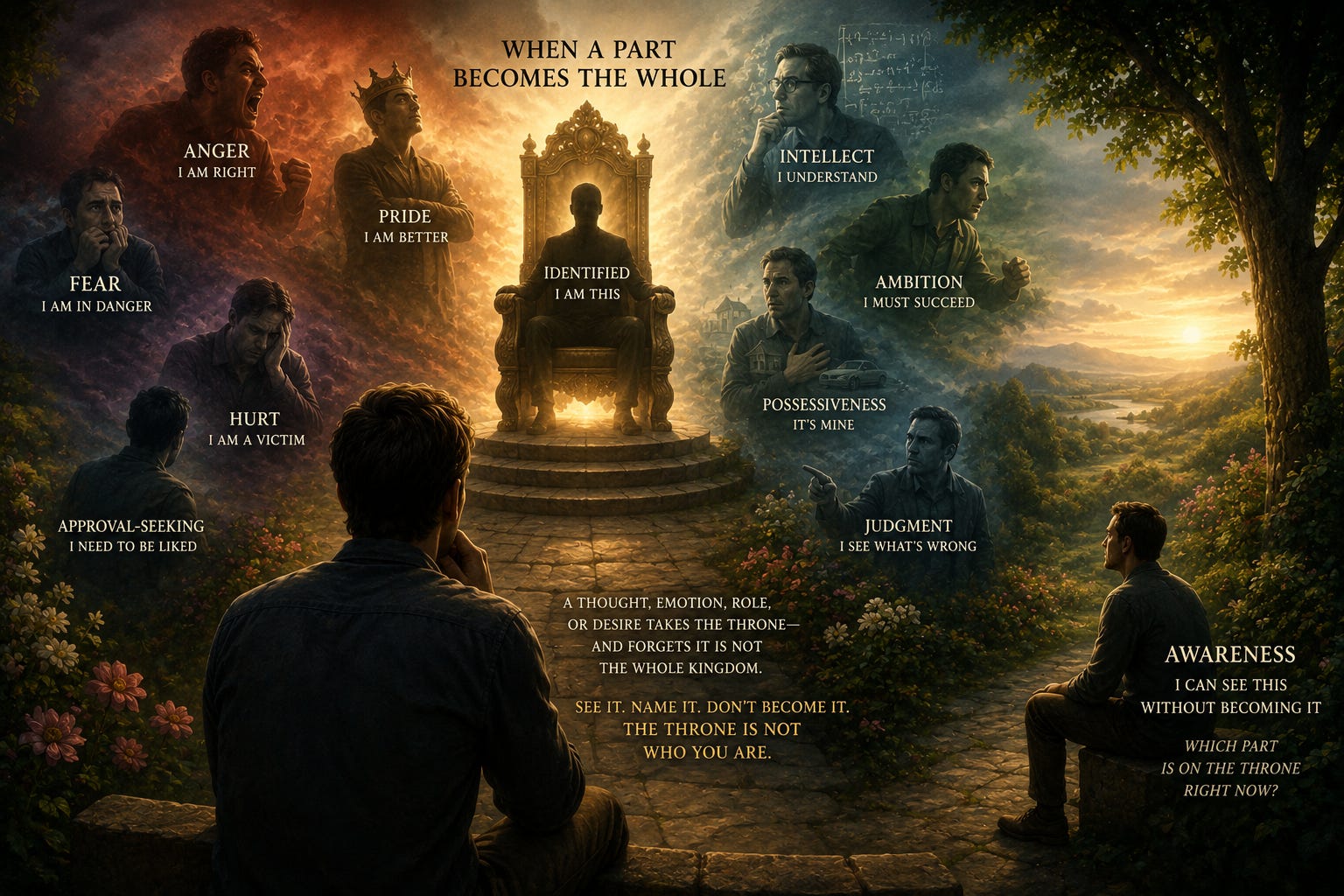
In the last article, we explored the idea that what we normally call “I” may actually be made up of many different parts, impulses, emotions, habits, opinions, and reactions that take turns speaking for us. One moment we are patient, another moment irritated. One moment generous, another defensive. One moment determined to change, and a few hours later another part of us seems to have completely forgotten the decision. But simply having many different reactions within us is not necessarily the problem. The deeper issue begins when we become so caught up in one of them that, for a time, we no longer recognize it as merely one part of our inner experience. We become it. This is what is often meant by identification.
Identification happens when a thought, emotion, role, opinion, fear, desire, or reaction becomes so completely joined with our sense of self that we can no longer see it objectively. Instead of noticing, “Anger is arising in me,” we simply become angry. Instead of noticing, “A part of me feels threatened,” we become the threatened person. Instead of recognizing, “I have a strong opinion about this,” the opinion becomes part of who we believe ourselves to be. At that point, challenging the opinion can feel almost like challenging our very existence.
When the Part Becomes the Whole
Imagine receiving an email that immediately irritates you. Before opening it, you may have been perfectly calm. Then a few words enter through your eyes and something begins to happen. Your body tightens, your thoughts accelerate, and you begin constructing a response. Perhaps you reread the message several times, each time finding another sentence that bothers you. Within minutes, your entire inner world may revolve around that email. Nothing outside has changed except a few words on a screen, yet internally one reaction has expanded until it fills nearly the whole field of consciousness. For that moment, irritation is not simply something you are experiencing. It has become you.
The same thing can happen with fear. We hear something concerning about the economy, our health, world events, or someone we love. A legitimate concern may arise, but instead of remaining one piece of information among many, it begins occupying more and more of our attention. Soon we are imagining every possible outcome, and the body starts responding as though those imagined possibilities are already happening. Identification does not only happen with unpleasant things either. Someone may praise us, and we naturally feel good. But then another part appears that wants more praise. We replay the compliment, begin thinking about how others see us, and may even start protecting the image that brought us the approval. We can identify with being admired just as easily as we identify with being rejected.
In fact, we can identify with almost anything. We can identify with our occupations, possessions, families, beliefs, political opinions, appearance, accomplishments, failures, memories, and the stories we tell about ourselves. Someone criticizes our profession and we feel personally attacked. Someone questions a political position we hold and our body reacts before we have even considered what was said. Someone challenges a religious belief and we may immediately feel the need to defend not only the idea, but ourselves. We can identify with being the person who is always right, the victim, the helper, the responsible one, the strong one, the spiritual one, the intelligent one, or even the person who believes he has moved beyond identification. That last one is particularly clever, because the ego can put on almost any costume, including a spiritual one.
All of us also live through roles. We may be a husband or wife, parent, grandparent, employer, employee, farmer, teacher, pastor, supervisor, friend, caregiver, or neighbor. These roles are useful and necessary. Problems arise only when we forget that a role is something we perform rather than the totality of who we are. A parent may become so identified with being needed that when the children become independent, there is a deep sense of loss. A person may become so identified with a career that retirement feels like the disappearance of self. Someone who has spent years being “the strong one” may find it almost impossible to admit weakness or ask for help. Even our history can become an identity. We say, “I have always been this way,” “That is just who I am,” or “I am the kind of person who…” Those statements may contain some truth, but they can also become invisible walls. Some of what we call personality may simply be patterns we have practiced for so long that we can no longer imagine ourselves without them.
Identification Narrows the Field
One of the easiest ways to recognize identification is by what happens to our awareness. It becomes narrow. When we are deeply identified, we usually see only the part of reality that supports the state we are already in. If we are angry, we remember everything the other person has ever done wrong. If we are afraid, we notice every possible danger. If we are jealous, we interpret innocent events as evidence. If we are proud, we remember our accomplishments. If we feel rejected, we begin collecting proof that nobody appreciates us. Our inner state starts selecting the evidence, and because the evidence seems so convincing, we rarely realize that our field of vision has become smaller.
This helps explain why arguments are so difficult to resolve when both people are identified. Each person sees the situation through a narrowed field shaped by emotion, past experience, and the desire to be right. Both may sincerely believe they are simply seeing reality. Neither may realize how much their inner state is determining what they notice and what they ignore.
The body can help us recognize this process earlier than the mind does. There may be a tightening in the abdomen, the shoulders rise, the jaw clenches, breathing changes, the heart rate increases, or heat rises into the face. Often the body reacts before the mind has fully constructed the story that explains the reaction. This makes bodily sensation a kind of early-warning system. Something is said. The stomach tightens. A thought appears, then another, then the urge to respond. If we can notice the process early enough, we may catch identification while it is happening rather than only recognizing it afterward.
At first, that may happen long after the event. We may recognize the next day that we were completely caught in a reaction. Later, perhaps we see it an hour afterward, then ten minutes afterward, and eventually while it is still happening. Progress in this kind of work may not mean that we suddenly stop having reactions. It may simply mean that we begin remembering sooner. Eventually, there may come a moment when an impression enters, the reaction begins, and somewhere between the two awareness appears: “I can feel myself reacting.” That tiny moment changes everything, because now the reaction is no longer completely invisible.
The Space Between Impression and Response
There is a small space between an impression and our response. At first it may seem almost nonexistent. Someone says something irritating and the reaction appears immediately. But with practice, the space can begin to widen. The impression comes in, the reaction begins, and awareness appears before the process is complete. This does not guarantee that we will respond wisely. We may still say the wrong thing, become angry, or get pulled into the old pattern. But something has changed. We remembered ourselves before the whole process finished.
Suppose someone says something that feels insulting. Ordinarily the reaction may be nearly automatic. But this time we notice the body tighten, we feel the urge to respond, and we wait. Perhaps only three seconds. During that pause, several possibilities appear that otherwise would have remained invisible. Maybe the person did not mean the remark the way we heard it. Maybe they are having a terrible day. Maybe there is some truth in what they said. Maybe the best response is to ask a question. Maybe no response is needed at all. The impression has not disappeared, and the emotion may still be there, but the reaction is no longer the only possible future.
This is where freedom begins to enter, and it is important to understand that non-identification does not mean indifference. The goal is not to become detached in the sense of no longer caring. If someone is suffering, compassion may require us to become deeply involved. If injustice occurs, we may need to act. If someone we love is in danger, fear may arise for a perfectly good reason. Non-identification simply means that the emotion does not completely possess us. We can feel anger without allowing anger to decide everything we do. We can experience fear without allowing fear to become the ruler. We can hold a strong opinion without needing to destroy anyone who disagrees. We can love someone deeply without making our own identity dependent on that person’s approval. This is not less feeling. It may actually be a more conscious form of feeling.
Returning to the Throne
The image of the throne becomes useful again here. A lesser king does not necessarily seize power because it is evil. More often, it simply arises and finds the throne unattended. Fear appears and sits down. Anger appears and sits down. Pride appears and sits down. The need to be right appears and sits down. The desire for approval appears and sits down. Once seated, each begins issuing orders as though it represents the whole kingdom.
Self-observation does something very simple: it notices who is sitting there. That awareness alone begins changing the situation. We might ask, “What has taken the throne right now?” or “What part of me is answering?” Then perhaps the most important question of all: “Can I see that part without becoming it?” The answer will not always be yes, but even asking the question introduces something that was not present before—awareness.
This way of looking inward may also help us hear some of Jesus’s teachings differently. Again and again, Jesus challenged people to release identities they had taken to be absolute. Social standing, religious reputation, possessions, family expectations, status, and even personal righteousness could all become attachments strong enough to prevent someone from seeing clearly. The rich young ruler is an obvious example. His possessions were not necessarily evil, yet something about his relationship to them had become binding. The Pharisee who thanked God that he was not like other people had become identified with his own righteousness. Those who competed over who would be greatest had become identified with rank and importance.
Jesus continually pointed beyond the identities people had constructed: lose your life to find it, become like a child, the first shall be last, do not perform righteousness merely to be seen. These teachings become especially interesting when read inwardly. What if part of losing our life means releasing our identification with the personality we have mistaken for the whole of ourselves? Not destroying personality, rejecting our history, or becoming passive, but no longer allowing every temporary role, reaction, opinion, and self-image to define who we are.
A Simple Practice
For the next few days, don’t try too hard to become less identified. That effort itself can become another identification. Instead, simply notice the moments when your world suddenly becomes small. Something happens, and your attention becomes consumed by it. You replay a conversation. You imagine an argument that has not happened. You keep checking whether someone responded. You feel the need to prove your point. You begin defending yourself internally even though nobody is present. You cannot stop thinking about what someone thinks of you.
These are useful moments. Instead of saying, “I should not be doing this,” simply ask, “What am I identified with right now?” Then notice what is happening in the body. Notice the thoughts. Notice the story. See whether there is even a small part of you capable of observing the entire process. If so, remain there for a moment. No fighting. No suppressing. No judging. Just seeing.
We often imagine freedom as having the ability to do whatever we want, but what if many of the things we “want” are simply temporary impulses produced by whichever part happens to occupy the throne? Perhaps a deeper freedom begins when we are no longer compelled to obey every thought, emotion, impulse, and identity that passes through us. A thought may arise without becoming a command. An emotion may arise without becoming an identity. An insult may arrive without demanding retaliation. A compliment may arrive without needing to become self-importance. Fear may speak without becoming king.
That is a very different kind of freedom. It is inward freedom. And perhaps that is one reason self-observation matters so much. We cannot become free from something we do not know is controlling us. The first step is not conquering it. The first step is seeing it.
Then, gradually, we begin to recognize that what we experience is not necessarily the same thing as who we are. A thought appears. An emotion appears. A role appears. A reaction appears. They come, and they go. Yet something remains capable of seeing them.
And once again we arrive at the quiet question underneath everything we have been exploring:
Who is watching?
If you are starting here you may wish to start at chapter 1 or back to chapter 2.
Coming Next
In the next article, we will look more closely at the different functions or centers within us—thought, emotion, instinct, movement, and the other forces that shape how we respond to life. Rather than treating these parts as enemies, we will begin exploring what each one is designed to do, what happens when one takes over work that does not belong to it, and why putting the inner kingdom in order may be very different from trying to suppress parts of ourselves.
If this series speaks to something you have been sensing in your own life, feel free to share it with someone who may be asking similar questions. We are not trying to establish another system of beliefs. We are exploring together, testing these ideas in our own experience, and seeing where the search for truth leads.
A Note About This Series: During this series, it may seem that there is some repetition. This is intentional. These ideas are not meant simply to be understood intellectually, but gradually integrated into our everyday awareness. Repetition and reminders can help bring patterns that normally remain beneath conscious awareness into the surface mind, until observation becomes more natural and less something we have to strive to remember. Also, throughout these chapters, references to the lesser “king” or the king attempting to take the throne are generally referring to the ego and our mechanical reactions—not to Christ or the true spiritual King.