


If you are joining us here you may wish to start at chapter 1 or go back to chapter 9.
One of the strangest discoveries in self-observation is that seeing something within ourselves does not necessarily mean we are free from it. We may recognize anger, fear, pride, worry, resentment, or the need to be right, yet a moment later find ourselves completely caught in it. There is a difference between having an emotion and becoming identified with the emotion. That difference may seem small at first, but it lies near the heart of the work we have been exploring.
Imagine that someone says something that irritates you. At first there may simply be an impression: words enter your ears, the face of the other person is before you, and something begins to stir inside. Perhaps there is tightening in the abdomen or shoulders. A thought appears: That isn’t fair. Another quickly follows: They shouldn’t talk to me that way. Within seconds, an entire inner story can form. We are no longer simply observing irritation. We have entered it.
At that point we don’t usually think, There is irritation occurring within me. We think, I am irritated. We don’t notice that fear is appearing; we simply say, I am afraid. We don’t recognize that a part of us wants to prove that it is right; instead, we become the one who must be right. This is what the Fourth Way calls identification.
The Disappearing Observer
Identification is so ordinary that we rarely recognize it. Something captures our attention, and for a time it becomes our entire world. The observing presence that we have been developing seems to disappear. Consider how easily this happens while listening to the news, watching a political discussion, arguing with someone we love, worrying about money, receiving criticism, or remembering something painful from years ago. The event itself may be relatively small, but internally it becomes enormous. Our attention contracts around it.
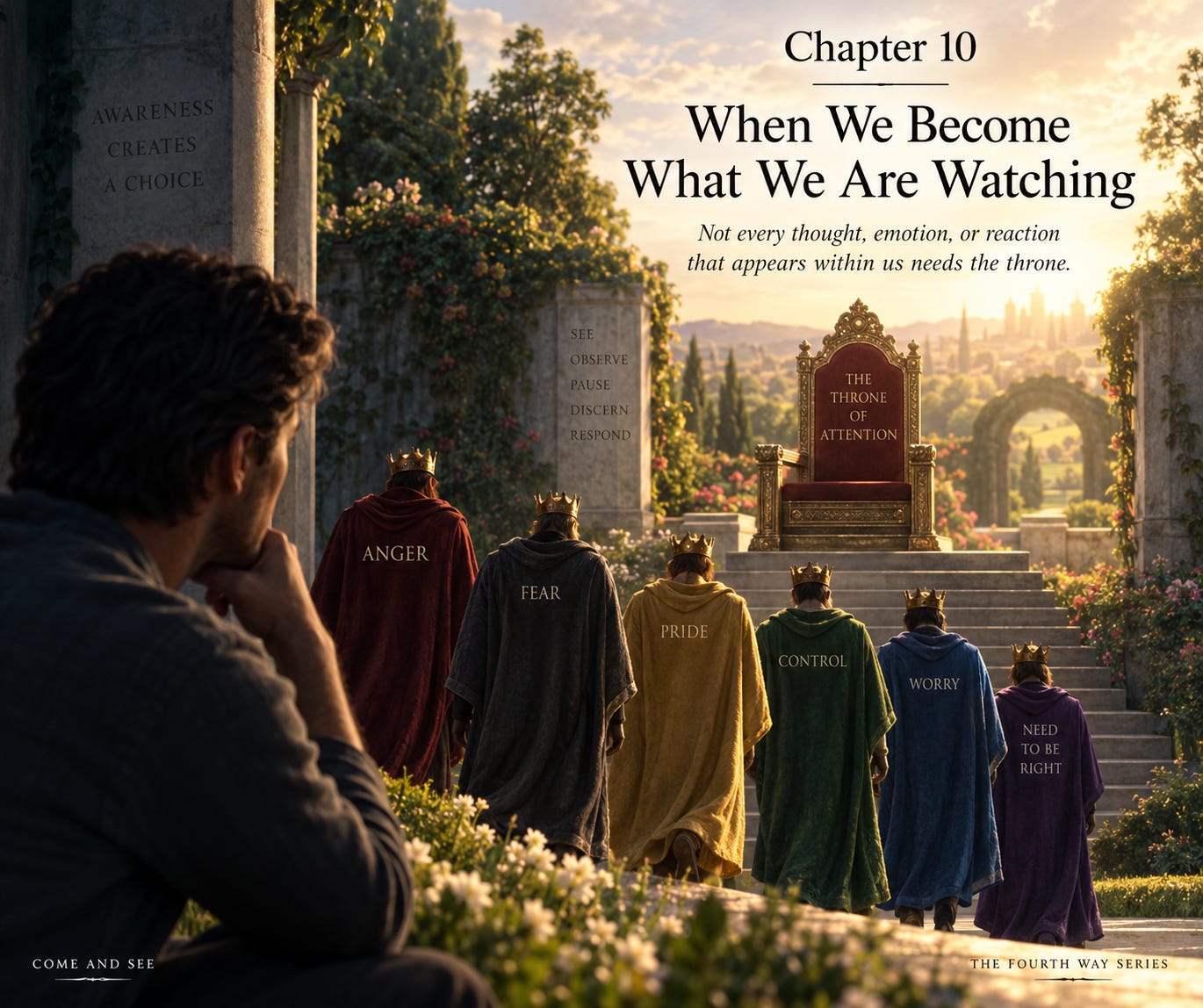
When this happens, one of the many selves we discussed earlier has effectively stepped onto the throne. It might be the offended self, the frightened self, the part that needs recognition, the part that wants control, or the part that cannot tolerate being wrong. For those few minutes—or sometimes hours or days—that particular self may speak as though it represents our entire being. The remarkable thing is that, while we are identified with it, we usually believe that it does.
The King Has Left the Throne
This brings us again to the image at the center of this series: Who is sitting on the throne? We have already seen that the different parts of ourselves are not necessarily enemies. Emotion has a proper function. Intellect has a proper function. Instinct protects us, and the moving center allows us to act. Ambition can accomplish things, caution can keep us from unnecessary danger, and even fear can sometimes warn us of something important. Each of these lesser kings has its place.
The trouble begins when a lesser king forgets that it is a servant and declares itself sovereign. Identification is one of the ways this happens. An emotion rises, and instead of being something we experience, it becomes the ruler of the Garden. A thought appears, and instead of being examined, it becomes truth. Fear speaks, and suddenly every other voice is silenced. Nothing may have physically changed around us. What has changed is who occupies the throne of our attention.
The Space Between Impression and Response
This is why self-observation is so important. It begins to create something that mechanical life seldom gives us: space. Someone says something, an impression enters, and something begins moving within us. Then, perhaps only for a second, we see it. That second matters.
We may feel the tightening in the stomach before the angry words come out. We may notice ourselves preparing an argument before the other person has even finished speaking. We may recognize the desire to defend ourselves or notice the little rush of satisfaction that comes from imagining how we are going to prove someone wrong. None of these things needs to be condemned. They simply need to be seen.
That tiny moment of seeing creates the possibility of choice. Without awareness, life can follow an almost automatic sequence: an impression enters, a reaction occurs, and an action follows. But when awareness appears, something new becomes possible. The impression can be followed by awareness, then a pause, then discernment, and finally a conscious response.
The outward response may occasionally be exactly the same as it would have been before. We may still need to say no. We may still need to disagree. We may still need to defend a boundary or correct something that is wrong. The difference is that the response can now come from a different place within us.
Can I See It Without Becoming It?
One of the most useful questions we can carry into ordinary life is very simple: Can I see this part of myself without becoming it? If anger appears, can I feel the anger without immediately giving it authority? If fear appears, can I listen to what fear is telling me without automatically obeying it? If someone challenges one of my beliefs, can I notice the urge to defend myself without immediately becoming the defender?
This does not mean suppressing anything. Suppression says, I shouldn’t feel this. Observation says, This is what is here. Those are very different attitudes. We are not trying to throw anyone out of the Garden. We are learning to recognize who has entered it and whether that part should be given authority.
The Body Often Knows First
There is another useful clue in this work: the body often recognizes identification before the mind does. The shoulders tighten, the stomach contracts, the jaw stiffens, breathing changes, or the heartbeat becomes more noticeable. We may lean forward, our voice may change, and something within us begins preparing for action before our thinking mind has completely understood what is happening.
These bodily sensations can gradually become bells of awareness. Instead of thinking, I shouldn’t be feeling this, we can become curious. What just happened inside me? Which part of me has awakened? What does it want? What is it afraid of? Does it really need to act? And perhaps most importantly, who is watching it?
That last question leads somewhere very interesting. If I can observe fear, then there is something within me that is not identical to the fear. If I can observe anger, there is something present that is not identical to the anger. If I can watch thoughts passing through my mind, perhaps I am not simply the thoughts themselves.
We do not need to rush to define what that observing presence is. In fact, it may be more valuable to experience it than to name it. This series is not asking the reader to accept another belief system. It is offering an experiment: come and see.
Progress Is Remembering Sooner
There is a temptation when beginning this kind of work to measure progress by how peaceful we become. We imagine that if we were truly growing, anger would disappear, fear would disappear, irritation would disappear, and nothing would disturb us. But perhaps there is a much more realistic way to measure progress: How soon did I remember?
Perhaps in the past we remained angry for three days before recognizing what had happened. Later we notice after three hours. Eventually we notice after three minutes. Then one day, in the middle of a conversation, we feel the reaction forming and recognize it before the words leave our mouth. The reaction may still be there, but something else is there too: awareness.
That is an enormous change. The Garden has not become empty, and the lesser kings have not vanished. They are beginning to be recognized before they seize the throne. Progress may not mean that we never become identified again. It may simply mean that we awaken from identification sooner.
A Practice for This Week
During the coming days, don’t try to stop yourself from becoming identified. That can easily become another form of inner struggle. Instead, simply try to catch one moment of identification. It might happen while listening to the news, during a disagreement, while worrying about something that hasn’t happened, when someone criticizes you, or even when someone praises you.
Notice what happens in the body. Notice the thoughts that appear. Notice how quickly one part of you begins speaking as though it represents the whole of you. Then quietly ask yourself: Which part of me is answering? Can I see that part without becoming it? What is on the throne right now?
Do not be discouraged if you recognize the identification only afterward. That recognition itself is part of awakening. Yesterday we may not have seen it at all. Today we see it afterward. Tomorrow we may see it while it is happening. Eventually there may come that remarkable moment when an impression enters the Garden, a familiar king begins walking toward the throne—and someone is already there watching him come.
That is where mechanical reaction begins to lose some of its power, and it is where freedom quietly begins.
Coming Next — Chapter 11: Remembering Yourself
If self-observation allows us to see what is happening within us, another question soon arises: Who is doing the observing? In the next chapter, we will explore one of the most intriguing ideas in the Fourth Way—self-remembering—and why being aware of what we are doing is not necessarily the same thing as being aware that we are here while doing it.
A Note About This Series: During this series, it may seem that there is some repetition. This is intentional. These ideas are not meant simply to be understood intellectually, but gradually integrated into our everyday awareness. Repetition and reminders can help bring patterns that normally remain beneath conscious awareness into the surface mind, until observation becomes more natural and less something we have to strive to remember. Also, throughout these chapters, references to the lesser “king” or the king attempting to take the throne are generally referring to the ego and our mechanical reactions—not to Christ or the true spiritual King.
If this series speaks to you, consider sharing it with someone who may also be interested in exploring the inner life. These ideas are not offered as something you must believe, but as something you can test for yourself. Come and see.