

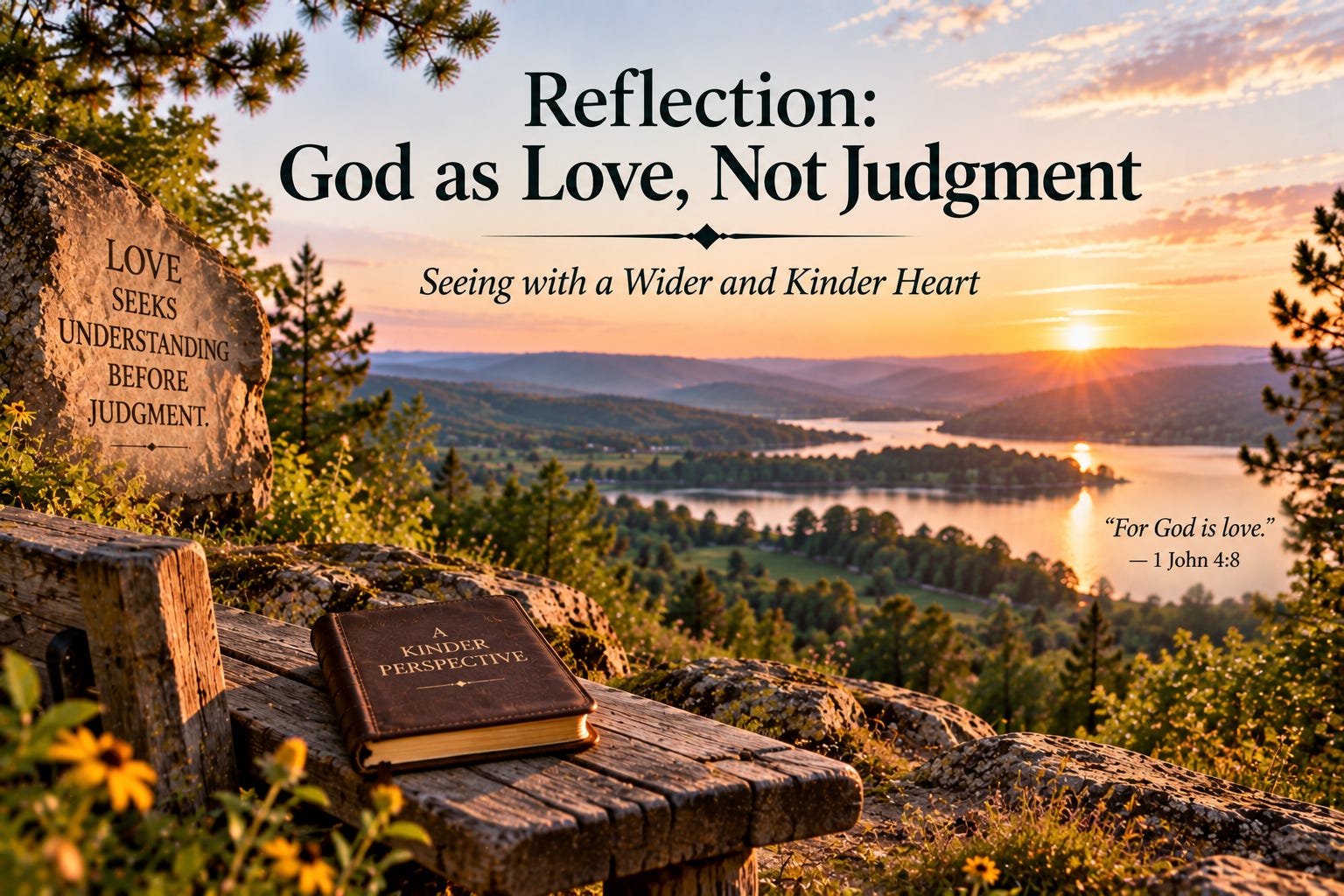
As a short Sunday morning ponder, I don’t see God as a distant ruler keeping score. Using the word God also limits, as history shows there were many who forced their subjects to worship them as God, which distorts their view.
I really don’t picture Him sitting on a throne, weighing sins and handing out punishment. I used to see Him that way, but not anymore. He is the God of relationship and not religion though he can be found in religion. He is all that is and all that can be!
The more I’ve paid attention, especially to the love of a mother for her children, the more I’ve come to understand God’s love. Only deeper. Far deeper. A zillion times deeper.
To me, God is the Father of fathers, the source of life itself, the place where love and meaning begin. I also believe God sees through our eyes, feels our emotions, and knows our pain firsthand.
I don’t think God punishes.
I think He understands, more deeply than we can imagine. I think He reflects.
Life has a way of showing us where we’re out of alignment, if we’re willing to pay attention. What we often call punishment is usually the result of our own choices colliding with reality, even if reality is perceived differently by each of us.
God’s love isn’t conditional, just like a mother’s love.
I once asked one of my daughters what the boys could do to make her love them more. She didn’t even hesitate. She just said, “Nothing.” Do you really think God is less than this?
His love doesn’t come and go based on how well we behave. It’s simply there — the constant presence in which everything else happens.
I’ve come to believe that knowing God and loving God aren’t two separate things.
The more you know Him, the more you love Him. And the more you love Him, the more clearly you see Him.
As that happens, something else fades away — judgment.
Not because standards disappear, but because alignment replaces accusation.
God doesn’t usually show up in great thunder or force.
More often, He’s found in quiet moments, when things slow down enough to listen. The small still voice. A gut feeling. A ray of sunshine that grabs your attention.
God doesn’t love like a father or a mother. He loves as a father and a mother.
He’s not someone to fear, but someone to come to know. And in that knowing, we begin to understand ourselves better. When the Bible talks about fearing God, I think it’s really talking about revering Him.
That’s where the Son comes in.
The Son makes God more personal. He shows us what the Father looks like when lived out in a human life. Through Him, what feels distant becomes close. I remember well when I had an awakening of how important it was to accept what Christ taught. It was during my early high school years. I think, though, it happened deep in my being at a much younger age. It was as if I had always known.
The Son, I believe, doesn’t judge. He restores, something we see over and over again in the Gospels.
He doesn’t condemn. He calls people back home. It’s we who judge ourselves and others when you get right down to it.
If you want to know what the Father’s heart looks like, look there. The Father and the Son are one; in a deeper sense, we are all one together on this journey back home.
Following the Son isn’t so much about rule-keeping. Rules help us get along while we’re here on this earth. Once this life closes and we step fully into spirit, we won’t need reminders about how to love; we’ll be immersed in it.
Following the lessons brought forth by the Son is about learning how to live aligned with love and truth, and letting that shape how we treat others. In the end, loving your neighbor as yourself is a lesson that we all still have a little more to learn.
It can be a long and difficult lesson, because each of us is walking in different shoes, shoes that have traveled many highways in life. Some have walked through homes where love was scarce. Some through loss so heavy it felt as if God Himself was to blame. Others grew up where pain and broken hearts shaped their view of the world, leaving little room for the light of Christ to shine through.
That’s why the old saying still matters: until you’ve walked a mile in another person’s shoes, you shouldn’t judge them. Most of us carry more than we let on, and it can block the divine light that otherwise would glow as it shines on us. God has given us free will. We even have free will to follow Him or not. I know one thing for sure: it is more profitable to follow Him than not.
I have come to realize there are unseen forces around us that, in a way, encourage and feed off of our low emotions. When we stay ignorant of this, we do not put up our defenses against this. With free will, we can step out of the box we have built for ourselves that prevents us from seeing the world for what it is. A place where we can live free or live in bondage to runaway emotions.
I decided many years ago to step out of the box I had built. One can become entrapped, for example, in a religious box, a political box, a science box, or even an archeological box. It does not matter what the box is; it only matters that the box will limit what you are allowed to see. That is why the walls need to come down.
When we put a limit on how we see things, we can miss what is right in front of us, which may be hidden behind the emotion we allow ourselves to exhibit. With this understanding,g you begin to see why there is so much division in the world. We need to ask the question, who or what really benefits from this division?
Free will is not overridden by God, as He will not interfere with the lessons we need to learn, as painful as they may be. Try to remember this the next time you blame God for something. Maybe a look in the mirror might just be needed.
God is here within us right now; all we need to do is become aware!
Well said my friend. One of the biggest blessings of all is the ability to embrace a new thought.