


When people protest, it’s usually because something feels wrong. Anger, grief, fear, and frustration don’t come out of nowhere. They grow from real experiences, real losses, and real injustices. Those emotions deserve to be acknowledged.
But acknowledging pain is not the same thing as abandoning the rule of law.
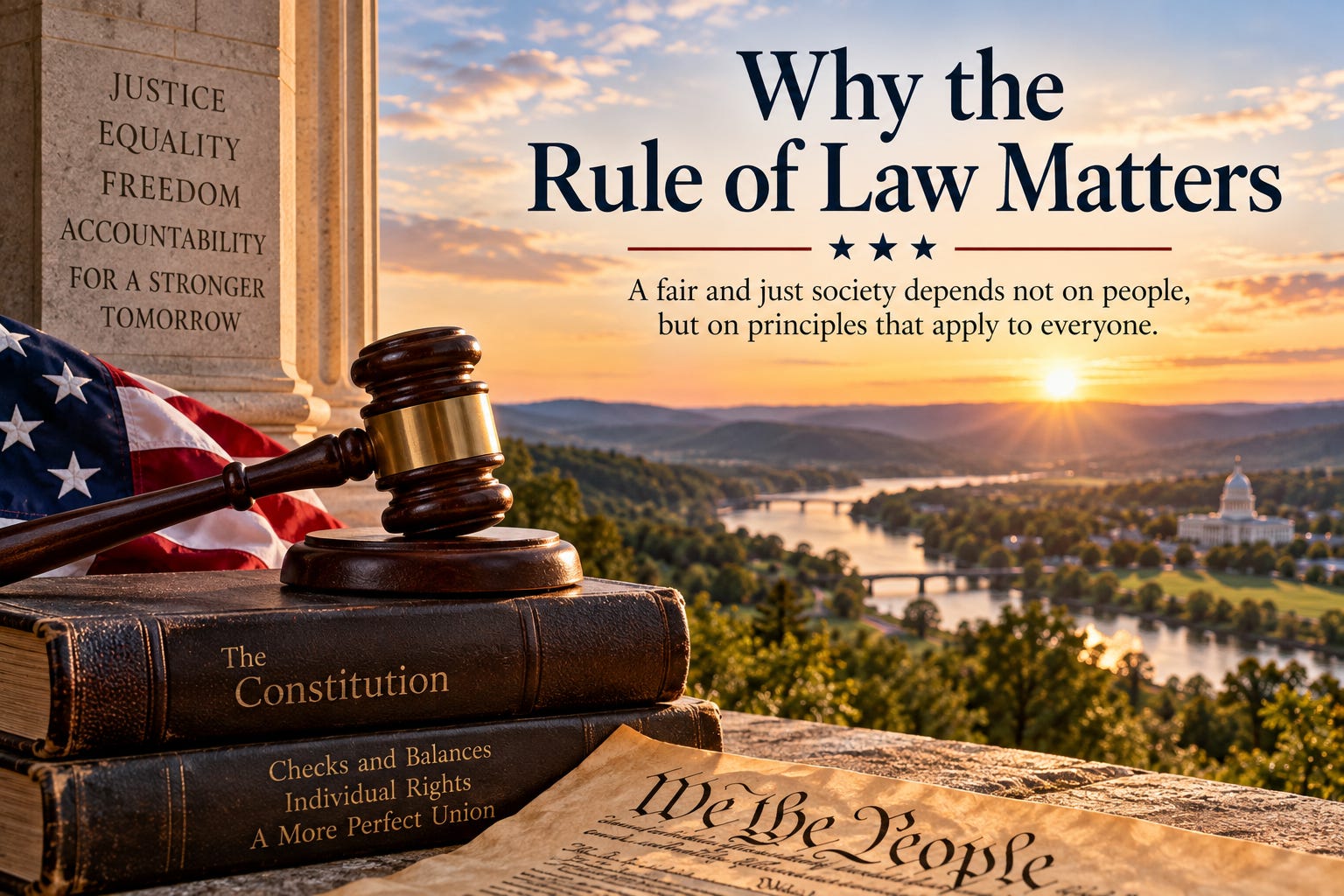
The rule of law often feels abstract—something discussed in courtrooms or classrooms, far removed from everyday life. In reality, it is one of the few things standing between disagreement and chaos. When it weakens, everyone feels it, especially those with the least protection.
We have seen moments like this before, including during unrest in places such as Minneapolis. The original cause may be serious and worthy of discussion, but once laws are ignored or selectively enforced, the situation changes quickly. Protest turns into destruction. Accountability turns into intimidation. Justice turns into raw power—whoever can take it, keeps it.
The rule of law exists for a simple reason: to ensure that justice is not decided by emotion, popularity, or force.
Without it, the loudest voice wins, not the fairest argument.
Without it, guilt is assigned before facts are known.
Without it, fear replaces trust, and neighbors become threats.
This is where an important distinction often gets blurred—sometimes accidentally, sometimes intentionally.
Peaceful protest and mob behavior are not the same thing, even though they often occur in the same place at the same time.
A peaceful protest is rooted in expression. People gather to speak, to march, to be seen, and to appeal to conscience and reason. It relies on persuasion. It accepts limits because it understands that one person’s rights must coexist with another’s. Peaceful protest works within the law even as it challenges the law, seeking reform rather than collapse.
Mob behavior is something else entirely.
A mob is not interested in persuasion—it is interested in force. Once a crowd shifts from expressing grievance to inflicting damage, it stops being a protest and becomes a tool of intimidation. Windows are not broken to make an argument. Fires are not set to persuade. Those acts are meant to overwhelm, silence, and dominate.
What makes this especially dangerous is that mobs are rarely accidental.
In nearly every large disturbance, some individuals arrive not to protest, but to provoke. Some are driven by ideology. Some by anger. Some by opportunism. Others simply enjoy the anonymity that chaos provides. They hide within legitimate protests because it gives them cover and credibility they could never earn on their own.
Once a mob takes hold, responsibility dissolves. Individuals feel less accountable because “everyone else is doing it.” Reasonable voices step back. The loudest and most aggressive set the tone. At that point, the original cause—however just—becomes secondary. Destruction becomes the message.
This is where peaceful protest is most at risk.
When protesters fail to separate themselves clearly and forcefully from mob behavior, they lose moral authority. Silence becomes permission. Tolerance becomes complicity. And the movement meant to demand justice ends up harming the very people it claims to defend—residents, workers, and small business owners who had nothing to do with the original grievance.
The rule of law draws this line clearly.
Peaceful protest operates within the law to challenge it, improve it, and refine it.
Mob behavior exists outside the law and seeks to replace it with fear.
One strengthens a society. The other fractures it.
History shows that breaking the rules “just this once” because the cause feels urgent is how the law erodes. Not all at once, but exception by exception. And once laws are bent for causes we agree with, they will eventually be bent for causes we do not.
When buildings burn, businesses close. When businesses close, jobs disappear. When jobs disappear, families suffer. The people most harmed are rarely the ones setting fires or shouting the loudest. They are the quiet ones—the elderly, the working poor, the shop owner who invested a lifetime into a single storefront.
Law is not the enemy of justice. Law is the structure that allows justice to exist at all.
A society without law does not become more compassionate—it becomes more dangerous. It does not become more equal—it becomes ruled by whoever is most willing to intimidate, destroy, or overpower others. That kind of power never stays in good hands for long.
If we care about justice, we must care about law. Not blindly. Not unquestioningly. But firmly enough to protect everyone—even those we disagree with.
Because when law no longer protects all, it eventually protects none.
Somewhere along the way, many of us seem to have lost a shared respect—and even a basic understanding—of how a nation is supposed to function.
A nation is not held together by anger, nor by whoever can shout the loudest or burn the most. It functions through agreed-upon rules, imperfect though they may be, and through a collective willingness to resolve conflict without tearing the whole structure down. When that understanding fades, frustration replaces responsibility, and force begins to look like a substitute for reason.
The rule of law is not a relic of the past. It is the quiet agreement that allows millions of people—who disagree on almost everything—to live side by side without fear. Once that agreement is dismissed, what follows is not progress, but instability.
If we want justice to endure, we must protect the framework that makes justice possible. Because a nation cannot function on outrage alone—it survives on restraint, responsibility, and the shared belief that law applies to all.