

For a long time, I thought trust came from knowing enough. If I had the facts, the experience, or the right advice, then I could move forward with confidence. Uncertainty felt like something to fix or eliminate.
Over time, I’ve learned that trust often shows up where answers don’t.
Trust can be very concrete. We trust that a chair will hold us when we sit down. Some people trust a bungee cord to hold when they jump off a high bridge. I’ve never done that myself, though I suppose after watching enough successful jumps, I might begin to trust it.
But there are other moments when decisions have to be made without clarity — when the next step isn’t fully visible, and waiting for certainty only creates more tension. In those moments, trust becomes less about information and more about willingness.
Those of us who were raised by loving parents often trust that they wanted the best for us, even when it didn’t feel that way at the time. That kind of trust is only fully understood in hindsight.
Trust isn’t passive. It doesn’t mean ignoring risks or pretending everything will work out. It’s a quiet choice to move forward without demanding guarantees — to accept that not everything can be understood in advance. We may trust in our ability to stay healthy or regain health, but that trust usually works alongside determination and effort.
I’ve noticed that trust often grows out of experience rather than explanation. You learn, sometimes slowly, that you’ve made it through difficult seasons before. Not perfectly, and not without mistakes, but you made it through. That memory becomes something to lean on. I remember being trapped in a silo when it was twenty below zero, and trusting that I would find a way to get myself out of there.
Trust also requires letting go of control, of timelines, and of the need to see the whole picture. When I try to manage every outcome, trust disappears. When I loosen that grip, trust has room to take shape.
There’s a difference between trusting blindly and trusting thoughtfully. Blind trust ignores reality. Thoughtful trust acknowledges uncertainty and moves anyway. It’s grounded, not reckless.
I’m also learning that trust deepens when I stop trying to force clarity. Some things reveal themselves only after you take the step, not before. Waiting until everything makes sense can leave you standing still.
In quieter moments, trust begins to feel less like a decision and more like a posture — a way of standing in the unknown without freezing up. When listening replaces anxiety and presence replaces worry, trust feels less fragile.
For many, trust also takes on a spiritual shape. Trusting in one’s beliefs about eternity, even without absolute proof, is a form of trust. Trusting that loved ones who have passed on are in a better place. Trusting that your life has had purpose — that you were not a mistake or an accident of existence.
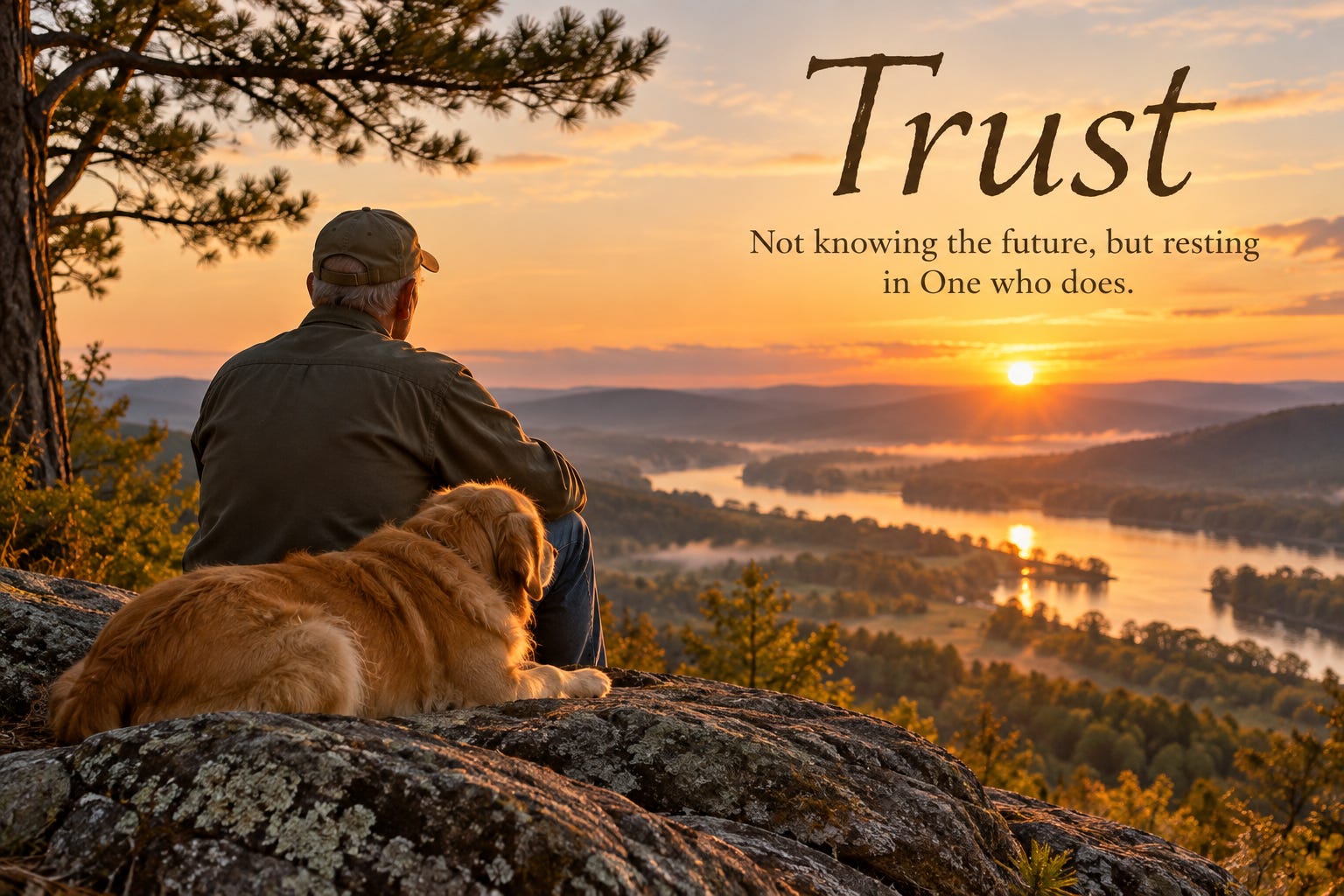
Maybe trust isn’t about having answers at all. Maybe it’s about being willing to walk forward without them — attentive, open, and ready to adjust as the path unfolds. I trust that I’ve gained some wisdom over these seventy-five years, and I suspect — or perhaps trust — that you have as well.
You being this round to a higher place. Nice work
Sometime tell me how you got out of the silo.