


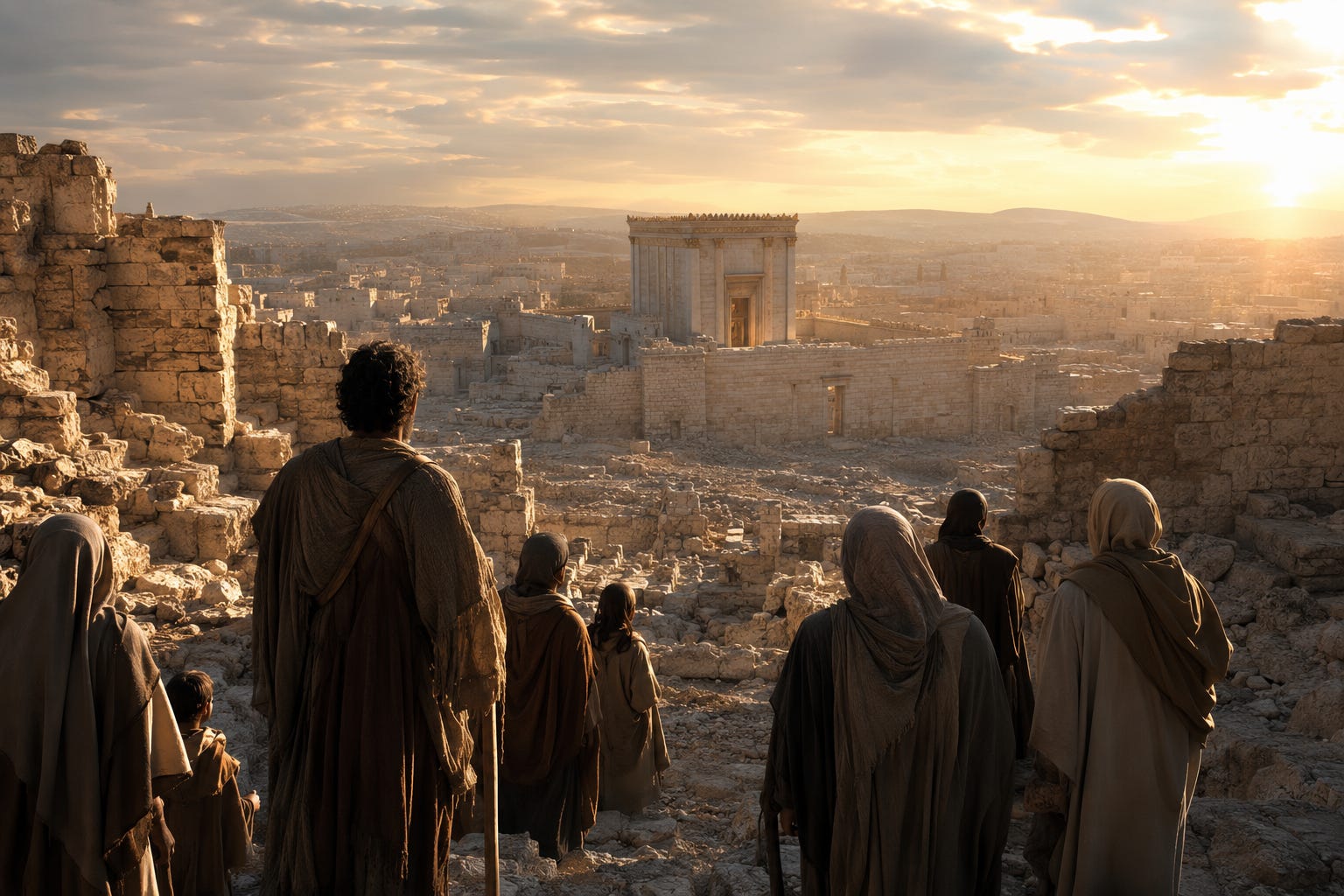
After decades of exile in Babylon, something unexpected happened. The Persian king Cyrus conquered Babylon and issued a decree allowing the Jewish people to return to Jerusalem and rebuild the Temple. The gates of captivity opened, and the people were given permission to go home.
On the surface, this was a political event. Empires rose and fell, rulers changed, and an exiled people were allowed to return to their homeland. Yet within the larger spiritual journey of the Bible, returning home represents something much deeper. It is the moment when the soul, having lived far from its true center, begins to remember where it belongs.
Exile had not merely separated the people from a geographical place. It had separated them from the Temple, their shared identity, their traditions, and the familiar rhythms through which they had understood their relationship with God. Babylon had become their outer environment, but it also symbolized the inner world of distraction, confusion, and misplaced loyalty that can gradually become normal to us.
This is one of the dangers of exile. At first, we know we are far from home. We feel the absence. We remember what has been lost. But as time passes, we begin to adapt. We learn how to survive in Babylon. We build houses there, raise families there, conduct business there, and eventually risk forgetting that we were ever meant to live differently.
The return begins when something within us remembers.
It may come as a quiet dissatisfaction with the life we have been living. It may come through grief, failure, prayer, a dream, an unexpected insight, or the growing realization that something essential has been missing. What once satisfied us no longer does. The values of Babylon begin to feel hollow, and we hear an inward call inviting us to return.
This return is not necessarily a return to the past. Spiritually, we cannot simply become who we once were. We return with everything exile has taught us. We return wiser, more humbled, and often less certain of ourselves. We carry both the wounds and the wisdom of the journey.
The people who returned to Jerusalem did not find the city waiting for them in its former glory. The walls were broken. The gates had been burned. The Temple had been destroyed. The place they had longed for existed largely as ruins.
This is often what happens when we begin returning to ourselves. We may imagine that spiritual awakening will immediately restore peace, clarity, and wholeness. Instead, we sometimes discover the extent of the damage. We see the neglected places within us, the broken relationships, the habits formed in exile, and the inner structures that can no longer support the life we are being called to live.
I remember my uncle’s farm well. As children, we sometimes stayed there when there was a death or serious illness at home. Years later, after my uncle sold the farm and moved to town, I drove back to see it. The buildings and land were still there, but the place felt empty. The soul had left, even though its material form remained. I sometimes feel something similar when, in my mind’s eye, I picture my parents here in the home where I still live. The house remains, but their living presence is gone. I can only imagine how the Hebrew people must have felt when they returned to Jerusalem and found the city and Temple in ruins. The physical place was still there, but its soul needed to return.
Coming home is not the end of the journey. It is the beginning of rebuilding.
Under the leadership of Zerubbabel, the returning exiles began rebuilding the Temple. Later, Ezra helped restore the spiritual teachings of the community, and Nehemiah led the rebuilding of Jerusalem’s walls. Each figure represents a different part of inner restoration.
The Temple represents the sacred center within us—the place where we become aware of the presence of God. Rebuilding the Temple means restoring spiritual life to the center of our being. It means making room again for prayer, silence, truth, conscience, and a living relationship with the Divine.
During exile, other things may have occupied that center. Fear may have sat on the throne. Anger may have directed our decisions. Success, security, approval, resentment, or the need for control may have become the organizing forces of our lives. Returning home means removing these false rulers and rebuilding our lives around something deeper.
The rebuilding did not happen easily. The people faced opposition, discouragement, delays, and internal disagreement. Some began the work enthusiastically but later lost heart. The unfinished Temple stood as a visible reminder that beginning a spiritual journey is often easier than continuing it.
We may experience the same thing. A moment of awakening can fill us with determination. We decide to change, forgive, pray, heal, or live more honestly. Yet the excitement eventually fades, and the slow work begins. Old habits return. Doubt speaks. Other demands compete for our attention. The inner Temple remains unfinished.
The prophets Haggai and Zechariah encouraged the people not to abandon the work. Their message was not merely about constructing a building. It was a call to restore the sacred center of their community.
Haggai challenged the people because they had rebuilt comfortable homes for themselves while the Temple remained in ruins. Symbolically, this asks us a difficult question: Have we built an outwardly successful life while leaving our inner life neglected?
We can spend years improving the exterior of our existence. We maintain our homes, careers, finances, reputations, and responsibilities, yet the deepest part of us may remain unattended. We can appear stable while inwardly living among ruins.
Returning home calls us to rebuild from the inside out.
When the foundation of the new Temple was laid, some of the older people who remembered Solomon’s Temple wept, while others shouted for joy. The new Temple seemed smaller and less magnificent than the one that had been destroyed.
This moment reveals something important about restoration. What is rebuilt after loss may not look exactly like what existed before. We often want God to restore the past precisely as we remember it, but spiritual renewal rarely works that way. The new life may be simpler. It may carry scars. It may lack the outward splendor we once valued, yet contain a depth that could only have been gained through exile.
There are times when we must stop comparing the life being born within us with the life that came before. The question is not whether the new Temple looks as impressive as the old one. The question is whether the presence of God can dwell there.
Ezra’s role in the return was to help the people rediscover the teachings that had shaped them. This represents the restoration of truth and spiritual understanding. Yet truth must become more than rules imposed from outside. It must be written within the heart.
Exile had shown the people that possessing the Temple and the Scriptures was not enough. Sacred institutions could not save them if their hearts remained unchanged. Returning home, therefore, required something deeper than restoring ceremonies. It required a renewed way of living.
The same is true for us. We may return to prayer, Scripture, worship, meditation, or other spiritual practices, but their purpose is not simply to make us feel religious again. They are meant to awaken compassion, humility, integrity, courage, and love. The outer practice is valuable when it helps rebuild the inner person.
Nehemiah’s work of rebuilding Jerusalem’s walls also carries symbolic meaning. Walls in the ancient world provided protection, identity, and a clear boundary between what belonged within the city and what did not.
Spiritually, rebuilding the walls may represent establishing healthy boundaries. As we awaken, we begin to recognize what we can no longer allow to enter and dominate our inner life. Not every thought should be welcomed. Not every influence should be given authority. Not every demand deserves our obedience.
Healthy spiritual boundaries are not walls of fear or separation. They are forms of discernment. They help us protect what is being rebuilt.
Nehemiah’s workers rebuilt while facing constant threats. Some labored with one hand while holding a weapon in the other. This does not need to be understood as a glorification of violence. Symbolically, it reflects the vigilance required during inner transformation. The new life within us may still be fragile, and old patterns do not surrender their territory easily.
When we begin rebuilding, resistance often increases. The voice of discouragement may tell us that the work is pointless. Shame may remind us of our failures. Fear may insist that we will never truly change. The habits of Babylon may call us back to what is familiar.
This is why returning home requires both openness and watchfulness. We remain open to God while becoming more aware of the forces within us that would pull us back into exile.
Not everyone chose to return to Jerusalem. Many had built lives in Babylon and remained there. This too is significant. The door to return may open, but no one can be forced through it.
There are parts of us that long for freedom and other parts that prefer familiarity. Even painful patterns can feel safe simply because we know them. We may pray for transformation while quietly resisting the changes that transformation requires.
The call to return is an invitation, not a command that overrides our will. We must decide whether we are willing to leave Babylon behind.
Returning home also does not mean rejecting everything learned in exile. The Jewish people emerged from Babylon changed. Their understanding of faith, identity, Scripture, and community had deepened. What appeared to be only a catastrophe became part of their spiritual formation.
Our own periods of exile can do the same. The years in which we felt lost may eventually teach us compassion for others who are lost. Failure may soften our judgment. Grief may deepen our awareness of what truly matters. Questions may purify a faith that had once depended on easy answers.
God does not necessarily cause every exile, loss, or hardship, but no part of the journey has to be wasted.
The return to Jerusalem, therefore, represents more than recovering what was lost. It represents becoming capable of carrying something new. The people returned not as the triumphant nation they had once imagined themselves to be, but as a humbler community learning to live faithfully within a much larger empire.
There is wisdom in this humility. Spiritual maturity is not always demonstrated by power, certainty, or outward success. Sometimes it appears as quiet faithfulness—the willingness to rebuild one stone at a time.
This story invites us once again to ask where it may be happening within ourselves. Where have we been living in exile? What has occupied the sacred center of our lives? What inner Temple has been neglected? Which walls need to be restored, not to shut others out, but to protect what is sacred within us?
We might also ask what we are being called to leave behind. Babylon can take many forms. It may be an identity built around past pain, an attachment to being right, a pattern of resentment, a fear of change, or a life organized around approval and appearances.
Returning home begins when we recognize that these things are not our true dwelling place.
Home, in the deepest spiritual sense, is not merely a location. It is the state of being in which the human heart is aligned with God. It is the place within us where truth is no longer foreign, love is no longer weakness, and the Divine is no longer kept at the edges of life.
The journey home may be slow. The city may still lie partly in ruins. The Temple may be unfinished, and the walls may have gaps. Yet every stone placed with sincerity becomes part of the restoration.
We do not have to rebuild everything in a single day. We begin with the stone in front of us.
Perhaps returning home means forgiving someone. Perhaps it means facing something we have avoided. Perhaps it means becoming quiet enough to hear what our life has been trying to tell us. Perhaps it means allowing an old image of God to fall away so that a deeper relationship can emerge.
The exile taught us what separation feels like. The return teaches us that separation does not have to be permanent.
The road home has opened.
The question is whether we are ready to walk it.
Coming Next
The people had returned, the Temple had been rebuilt, and Jerusalem once again became the center of Jewish spiritual life. Yet the full promise still seemed unfulfilled. Foreign empires continued to rule, prophetic voices gradually became silent, and the people began waiting for someone who would bring true deliverance.
In Part 22, we will enter the long period of waiting and preparation that eventually leads to the coming of Jesus—and explore what it means when the soul becomes ready for a new revelation and what exceptional courage is.