


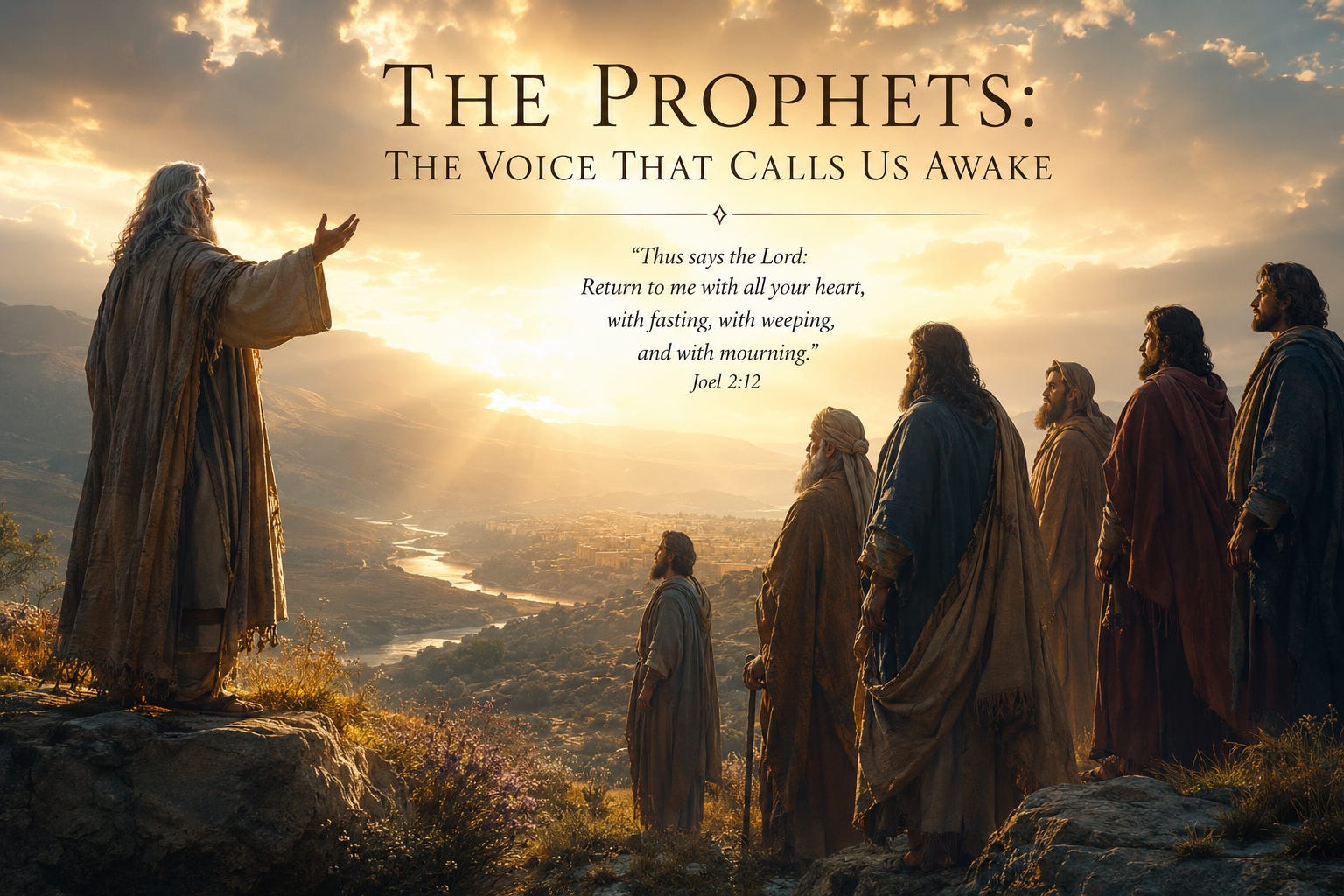
There comes a point in every spiritual journey when simply recognizing our struggles is no longer enough. We have seen humanity awaken to self-awareness in Adam and Eve, wrestle with the ego through Pharaoh, wander through the wilderness of transformation, conquer inner giants with David, build the temple of an integrated life under Solomon, and finally experience the painful division of the kingdom. By this point, the biblical story has painted an honest picture of the human condition. We are capable of tremendous beauty, yet we continually drift into fear, pride, greed, violence, and separation.
It is precisely at this moment that the prophets begin to appear.
Many of us were taught that the prophets existed primarily to predict future events. While some of their writings certainly look ahead, prophecy is far more than forecasting history. The prophets are the awakening voice of God calling humanity back to its deepest identity. Their message is timeless because it addresses something that exists within every generation—and within every one of us.
The prophets arrive whenever humanity loses its way. They speak when power becomes more important than compassion, when religion becomes more concerned with rituals than with love, when leaders seek their own glory instead of serving others, and when people forget that every human being bears the image of the Creator.
In symbolic language, the prophets represent something profoundly personal. They are the voice of conscience that quietly whispers within us. They are those moments when we sense that our lives have drifted from what we know is true. They are the gentle discomfort that refuses to let us settle for less than who we were created to become.
This voice is rarely loud. It seldom forces itself upon us. More often it appears as an uneasy feeling after we have spoken harshly to someone we love. It may come as an unexpected insight during a quiet walk, a dream that lingers long after we awaken, or a growing awareness that the life we have carefully constructed no longer reflects the person we truly wish to be.
Throughout history, societies have often resisted this prophetic voice. It challenges comfortable assumptions and unsettles established systems. The prophets questioned kings, confronted priests, defended the poor, and reminded nations that outward success means little if the heart has become hardened. Unsurprisingly, they were frequently ignored, mocked, or persecuted. The same resistance exists within us. Our ego prefers comfort over transformation. It would rather defend old habits than admit it needs to change.
Yet the prophetic voice never completely disappears.
It patiently calls us back, again and again. Not with condemnation, but with invitation. The goal of the prophets was never to shame people into obedience. Their deepest hope was restoration. They saw beyond humanity’s failures to the possibility of what we could become if we learned to live from love instead of fear.
Perhaps this is why the words of the prophets continue to resonate thousands of years later. Their message was never intended only for ancient Israel. It speaks to every age because every generation wrestles with the same temptations: to seek power instead of service, certainty instead of wisdom, division instead of unity, and control instead of trust.
The prophets remind us that spiritual growth is not merely about believing the right things. It is about becoming the kind of people whose lives reflect compassion, justice, humility, forgiveness, and love. Their words invite us to examine not only our societies but also our own hearts.
As we begin exploring each prophet individually, we will discover that every one of them reveals a different aspect of our own inner journey. Elijah will teach us to recognize God in the stillness rather than in the spectacle. Elisha will help us see beyond appearances. Isaiah will lift our vision toward a world transformed by peace. Jeremiah will reveal a covenant written not on stone but on the human heart. Ezekiel will show us that even dry bones can live again. Daniel will teach us how to remain faithful when surrounded by a culture that has forgotten its soul.
Taken together, the prophets are not merely voices from the past. They are companions on our own journey of awakening. Their words continue to echo through history because the work they began is still unfinished. Humanity is still learning to hear the quiet voice that calls us away from fear and back toward love.
Perhaps that is the true purpose of prophecy. It is not simply to tell us what lies ahead. It is to awaken us to who we can become.
Coming Next:
Elijah: Discovering God in the Still Small Voice
Before God speaks through great visions or dramatic miracles, He first teaches us to listen. In our next article, we’ll explore why one of the Bible’s greatest prophets discovered God’s presence not in the wind, the earthquake, or the fire, but in the silence that followed—and what that teaches us about hearing the divine voice within ourselves.