


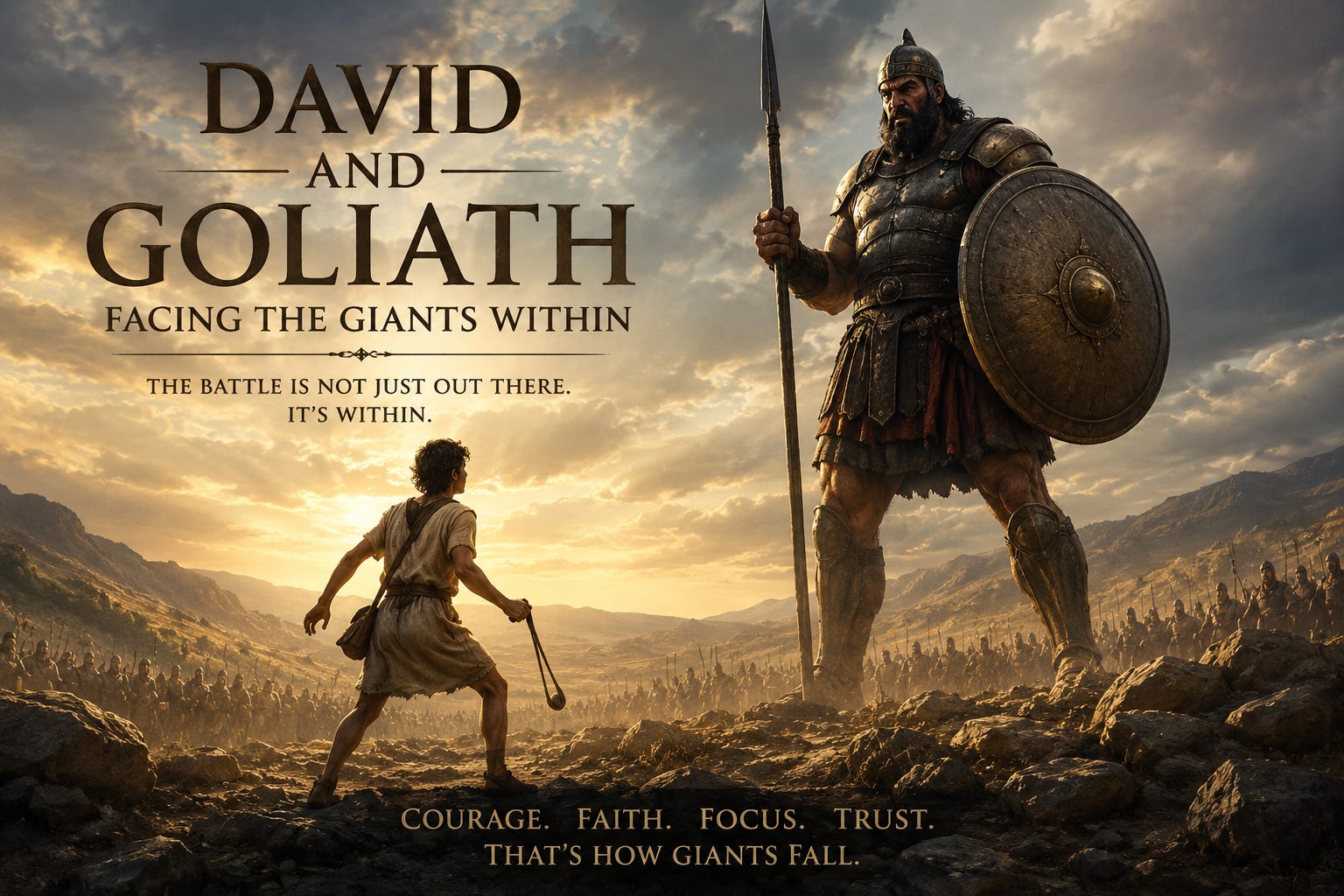
Few stories in the Bible are more familiar than that of David and Goliath. It is often told as the story of an unlikely victory, where a young shepherd defeats a giant warrior with nothing more than a sling and a stone. Yet beneath the historical narrative lies a story that speaks to every human being, because each of us encounters giants that no one else can see.
The Philistine giant stood before Israel day after day, filling the people with fear. The armies of Israel were strong, but they had become paralyzed. They saw only the size of the problem and had forgotten the strength that lay within them. Fear had already conquered them long before the battle began.
How often is the same true in our own lives? The giants we face are seldom nine-foot warriors clad in armor. More often, they are anxiety, resentment, shame, grief, pride, addiction, insecurity, or the fear of failure. Sometimes the greatest giants are not external circumstances at all, but the voices within us that continually whisper that we are too weak, too old, too broken, or too insignificant to overcome.
David represents something very different. He had no impressive armor, no great position, and no outward advantage. Yet he possessed something far more important. He had learned trust. Long before he faced Goliath, he had spent years tending sheep in lonely places. Those hidden years had formed something within him. In the wilderness and solitude, he had learned courage, patience, and dependence upon God.
Perhaps that is one of the deeper messages of the story. The battles we face publicly are often won or lost in the quiet places where no one is watching. Character is formed long before the giant appears.
Interestingly, David refused Saul’s armor. What worked for someone else would not work for him. He had to fight with the tools that had become natural to him. In the same way, our journey is not about becoming someone else. We are not called to wear another person’s beliefs, methods, or identity. We are called to discover the gifts and strengths that have been quietly developing within us throughout our own experiences.
The five smooth stones David gathered may themselves symbolize the simple qualities that enable us to confront our inner giants. Faith when fear tells us to retreat. Humility when pride seeks control. Patience when frustration demands immediate answers. Love when resentment tempts us to harden our hearts. Trust when uncertainty clouds the future.
The giant within us often appears overwhelming because the ego thrives on fear and separation. It convinces us that we stand alone and that our problems are too large to overcome. Yet again and again throughout Scripture, the message remains the same: strength is not found in power, possessions, or appearances. It is found in the quiet confidence that comes from living in harmony with the spirit of love and truth.
Perhaps that is why God so often chooses the small, the overlooked, and the humble. The kingdom does not advance through domination, but through transformation. The battle is not won by becoming greater than others, but by allowing love to become greater than fear.
And maybe this is why the story of David and Goliath continues to resonate after thousands of years. Every generation has its giants. Every person has battles that seem impossible. Humanity itself faces enormous challenges, and our progress often appears frustratingly slow. We move forward and then stumble backward. Yet growth continues. Two steps forward and one step back is still progress.
The story reminds us that giants are not defeated by becoming giants ourselves. They are overcome by remembering who we truly are and by trusting that what has been quietly growing within us is greater than the fears that stand before us.
The battle, in the end, is not merely out there.
It is within.
And that is where giants ultimately fall.
Coming Next
The Judges: Why We Keep Repeating the Same Lessons
Entering the Promised Land was not the end of Israel’s journey. In our next article, we’ll explore why spiritual growth so often unfolds in cycles of forgetting, remembering, stumbling, and beginning again—and why each new beginning brings another opportunity to grow.