


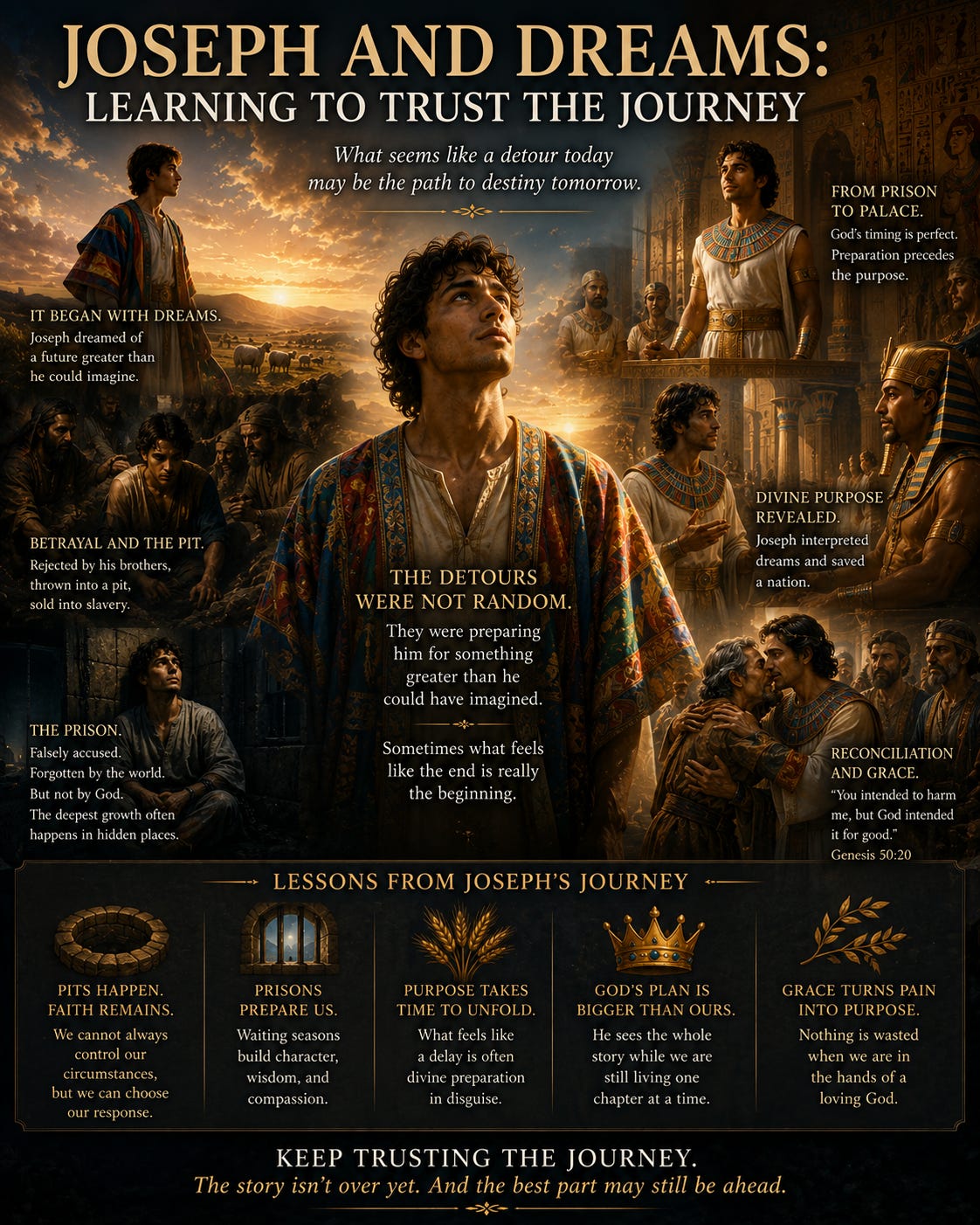
Among all the stories in the Bible, few seem to contain as many twists and turns as the life of Joseph. His story begins with dreams and eventually leads to reconciliation, but between those two points lie betrayal, injustice, loneliness, disappointment, and years of waiting. If we could have spoken with Joseph while he was sitting at the bottom of the pit or confined in an Egyptian prison, I wonder whether he would have been able to imagine where his life was eventually going. At times, it must have seemed that his dreams had failed and perhaps even that God had abandoned him.
Yet perhaps Joseph’s story is not merely about one man who lived thousands of years ago. Perhaps it is about all of us.
Joseph begins life with dreams. Like many young people, he is filled with expectation about what his life might become. His dreams suggest that something significant lies ahead of him, and perhaps in his youth he assumes that the path from the dream to its fulfillment will be fairly direct. Most of us probably begin life somewhat like that. We imagine the future without knowing very much about what will actually be required to reach it. We expect to marry, raise families, pursue occupations, build homes, accomplish things, and somehow move steadily forward.
But life rarely follows a straight road.
Joseph discovers that almost immediately. His brothers resent him, and eventually their jealousy becomes so intense that they strip away the special robe his father had given him and throw him into a pit. They first consider killing him, but instead he is sold into slavery and carried away to Egypt.
Imagine the change that must have occurred inside Joseph in a very short period of time. One day he is the favored son of his father, dreaming about the future. Soon afterward he is a slave being carried into a foreign land because his own brothers have betrayed him.
The dream must have seemed very far away.
Perhaps we all experience pits.
They may not be literal holes in the ground, but there are moments when something happens that suddenly separates the life we expected from the life we are actually living. Someone betrays us. A relationship ends. Our health changes. A career disappears. Someone we love dies. A plan we spent years developing collapses. Something happens in our family that we never imagined we would have to face.
We look upward and wonder how we got here.
And perhaps one of the hardest things about the pit is that we cannot see very far from the bottom.
When we are in the middle of a difficult experience, we naturally judge it by what we can see at that moment. We do not have the advantage of looking backward from twenty years in the future. We know only that something hurts, something has changed, and we don’t understand why.
Joseph certainly could not have looked up from that pit and seen the palace.
There were too many turns still ahead.
He is sold into the household of Potiphar, where he eventually earns trust and responsibility. For a time, perhaps it seems that his circumstances are finally improving. Then he is falsely accused and thrown into prison.
Another fall.
Another injustice.
Another place from which the original dream seems impossible.
Yet one of the remarkable things about Joseph’s story is that he continues to engage with the life immediately in front of him. He does not understand the entire plan. He cannot see where the road leads. But wherever he finds himself, he does what he can with what is available to him.
That may be one of the most practical lessons in his entire story.
We spend a great deal of our lives wanting to know what happens next. We want the map before we take the next step. But perhaps life rarely gives us the entire map. Joseph receives a dream, but he does not receive the route.
Maybe neither do we.
How many of us have found ourselves in prisons we never expected? Not prisons of stone and iron, but prisons of disappointment, grief, fear, illness, uncertainty, responsibility, or circumstances we cannot immediately change. Sometimes our prison may even be an identity we have carried for years. We may feel trapped by what happened to us, by what others expect from us, or by what we have come to believe about ourselves.
There are seasons when life simply will not move at the speed we want it to move.
Perhaps those periods can strip away some of our illusions. When we can no longer control the circumstances around us, we may begin discovering what is happening within us. We may learn patience because there is no way to hurry. We may discover strength because there is no other choice but to continue. We may find compassion because our own suffering finally allows us to understand someone else’s.
That does not mean the prison itself is good.
Joseph’s false imprisonment was an injustice.
The betrayal by his brothers was wrong.
And that distinction becomes especially important when we begin applying Joseph’s story to our own lives.
I know individuals who experienced terribly traumatic childhoods—childhoods involving different kinds of abuse and circumstances no child should have had to endure. When we look at experiences like these, I don’t think we need to say that God caused the abuse because the person needed a lesson. Something can be terribly wrong and still not have the final word over the life of the person who experienced it.
Perhaps Joseph gives us a better way of looking at this.
His brothers intended harm.
Joseph never says otherwise.
He does not eventually look back and declare that selling a young man into slavery was actually a good thing. The evil remains evil. What changes is Joseph’s understanding of what can come after it.
That leaves me wondering about people who have survived painful childhoods or other deeply wounding experiences. What if the question is not, “Why would God do this to someone?” Perhaps another question is, “What can this person become despite what was done to them?”
Can hatred eventually give way to forgiveness?
Can a person who experienced cruelty become unusually compassionate?
Can someone who grew up without healthy love eventually understand its value more deeply precisely because they experienced what love was not?
Can the cycle stop with them?
Perhaps that is one of the greatest victories possible. What was done to me does not have to determine what I give to someone else.
Forgiveness does not mean pretending the wrong was acceptable. It does not mean denying pain, eliminating appropriate boundaries, or excusing the person who caused the harm. It means that what someone else did does not have to remain the ruler of our inner life forever.
Perhaps that is another way of refusing to allow Cain to remain on the throne.
The person who was wounded may someday be able to say, “What happened to me was wrong. It affected me. It left scars. But it will not decide what kind of person I become.”
That is not weakness.
That may be one of the greatest forms of strength.
Joseph’s life also contains another element that has always fascinated me: dreams never disappear from his story. His journey begins with dreams, and while he is imprisoned he becomes the interpreter of the dreams of others. Eventually Pharaoh’s dreams become the doorway through which Joseph leaves prison and enters an entirely different chapter of his life.
Joseph is helping other people understand their dreams long before he fully understands his own.
There is something beautiful about that.
Sometimes we are able to help another person while our own life still contains unanswered questions. We don’t have to have everything figured out before we can be useful. Sometimes what we have learned while struggling becomes exactly what another person needs.
Dreams have also played an interesting part in my own life. I have remembered enough of them over the years that I have written many of them down. When I look back at them, something stands out. Many contain some kind of struggle. Sometimes I am back in my farming years trying to get crops planted or harvested. Something isn’t working properly. Time is running out. Something needs to be accomplished and I am struggling to get it done. Other dreams contain entirely different situations, yet again there is some challenge to overcome.
There seem to have been relatively few dreams in which everything was simply wonderful.
For a long time, I could look at that and wonder whether somewhere deep inside me there has always been a certain insecurity or concern about whether everything would work out. Perhaps that is part of it. Dreams may draw upon our memories, worries, experiences, and emotions in ways we do not fully understand.
But I also wonder whether struggle within dreams can sometimes serve another purpose.
Maybe dreams provide a kind of inner landscape where we encounter challenges without the restrictions of ordinary waking life. Perhaps they allow us to confront fear, frustration, loss of control, unfinished business, and uncertainty in symbolic form. I cannot say with certainty that dreams are preparing us for future struggles, but I find the possibility interesting.
Perhaps the important question is not always, “What does this dream predict?”
Maybe sometimes it is simply, “What is this dream showing me about myself?”
What am I struggling with?
What am I trying to accomplish?
What am I afraid of losing?
What keeps appearing?
Who is the person inside the dream who continues trying even when things become difficult?
In that sense, Joseph’s dreams and our own dreams may share something important. They invite attention. They ask us to listen to something beneath the surface of ordinary waking thought.
Joseph’s story also teaches us something about timing. He interprets the dream of Pharaoh’s cupbearer while in prison and asks the man to remember him when he is restored to his position.
Then the cupbearer forgets him.
Imagine that disappointment.
Joseph has finally found what appears to be a possible doorway out of prison, and the person who could help him simply goes on with his life.
Joseph waits again.
Two more years pass before Pharaoh has his dreams and the cupbearer suddenly remembers the man he met in prison.
Two years.
We can read those few verses in a matter of seconds. Joseph had to live them one day at a time.
That is something Scripture can sometimes hide from us simply because we know the ending. We read the pit, the slavery, the prison, and the palace within a few pages. Joseph lived through years in which he did not know there was going to be a palace.
We know how the story ends.
He didn’t.
And neither do we.
Eventually Joseph stands before Pharaoh. The very ability that had accompanied him from his youth—the ability connected with dreams—now becomes the means through which he is elevated to tremendous responsibility. Joseph interprets Pharaoh’s dreams as a warning of coming abundance followed by famine, and he is placed in charge of preparing Egypt.
Suddenly the prisoner becomes a leader.
But perhaps he could not have become the leader he eventually became without first becoming the man shaped through everything that came before.
The pit taught him something.
Slavery taught him something.
Responsibility in Potiphar’s house taught him something.
False accusation taught him something.
Prison taught him something.
Waiting taught him something.
Interpreting the dreams of forgotten prisoners taught him something.
The detours were becoming preparation.
That does not mean every painful event was deliberately arranged to hurt Joseph so that he could learn a lesson. It means that nothing had to be wasted.
There is a tremendous difference.
Perhaps that is true in our lives as well.
Many of us can look backward and recognize experiences we desperately wanted to avoid but that eventually contributed to who we became. A disappointment changed our direction. A physical limitation forced us to reconsider our future. A failure taught us something success never could. Someone else’s suffering awakened compassion within us. A door closed, and years later we realized that we had walked through another door we might never otherwise have noticed.
The meaning was invisible while we were living it.
Only later did the pieces begin fitting together.
That may be why Joseph’s eventual reunion with his brothers is so powerful. A famine brings them to Egypt looking for food, and they stand before the brother they sold years earlier without recognizing him.
Joseph now possesses tremendous power.
Think about that moment.
The roles have completely reversed.
The brothers who once had power over Joseph are now vulnerable before him. Joseph could punish them. He could humiliate them. He could make them experience some portion of what they had caused him to experience.
Perhaps this is Joseph’s greatest test.
The pit tested endurance.
The prison tested faithfulness.
But power tests the heart.
What will Joseph do when he finally has the ability to hurt those who hurt him?
Eventually he reveals himself, and the story moves toward reconciliation. Later, after their father dies, the brothers become frightened that Joseph may finally seek revenge. Instead, Joseph speaks words that contain one of the deepest insights in all of Scripture:
“You intended to harm me, but God intended it for good.”
What extraordinary words.
Joseph does not rewrite history.
He does not say, “You really didn’t mean to hurt me.”
They did.
He does not say, “What you did was good.”
It wasn’t.
He recognizes the evil intention while also recognizing that the evil intention did not control the final outcome.
Perhaps that is the heart of Joseph’s story.
What happens to us matters.
But what happens to us does not necessarily have the final word about who we become.
The pit does not know where the road ends.
Neither does the prison.
Perhaps we spend too much time judging the entire story from the chapter we happen to be living today.
If Joseph had judged his life from inside the pit, the story would have looked like betrayal.
If he had judged it from inside the prison, it might have looked like injustice and abandonment.
From the palace, looking backward, he could finally see connections that had been invisible before.
Maybe we are the same.
There may be things in my own life that I understand differently today than I did twenty, thirty, or forty years ago. Experiences that once seemed like endings became beginnings. Things I resisted helped redirect me. Questions that troubled me opened doors I might never otherwise have entered.
And there may still be things I do not understand.
Perhaps some pieces can only be understood farther down the road.
Maybe some will remain mysteries throughout this lifetime.
Faith may therefore be less about knowing exactly why everything happens and more about refusing to believe that the chapter we are presently living is the entire book.
Perhaps the soul has seasons.
There are times for dreaming and times when the dream seems to disappear. There are times for moving forward and times for waiting. There are times for certainty and times for questions. There are times for loss, struggle, learning, rebuilding, and eventually understanding.
Joseph experienced all of them.
And perhaps one of the greatest lessons he gives us is that God is not present only in the palace.
God can be present in the pit.
God can be present in the prison.
God can be present during the years when nothing seems to be happening.
God can even be present when the dream appears to have failed.
Maybe the dreams placed within us are larger than we imagine. Maybe their fulfillment will look nothing like what we originally expected. Perhaps what feels like a delay is not necessarily a denial.
And perhaps nothing that happens to us needs to be wasted.
The Garden asked us, “Where are you?” Cain asked, “Where is your brother?” Noah asked what remains when the familiar world disappears. Jacob asked what we are willing to wrestle with in order to become someone new.
Joseph brings us another question:
Can you trust the journey when you cannot yet see what the present chapter is preparing you for?
Perhaps that is faith—not pretending that the pit is pleasant, not calling injustice good, and not denying the pain of the prison.
It is simply refusing to believe that the pit is the end of the story.
Because sometimes the road to a place we could never have imagined runs directly through places we never would have chosen.
The dream may seem lost.
The dreamer may even change.
But the story is still being written.
And the journey home goes on.
Coming Next
Egypt and Pharaoh: Escaping the False King
What if Egypt represents more than a place on a map, and Pharaoh more than a ruler from long ago? What if they symbolize the inner bondage from which every soul must eventually seek freedom?