


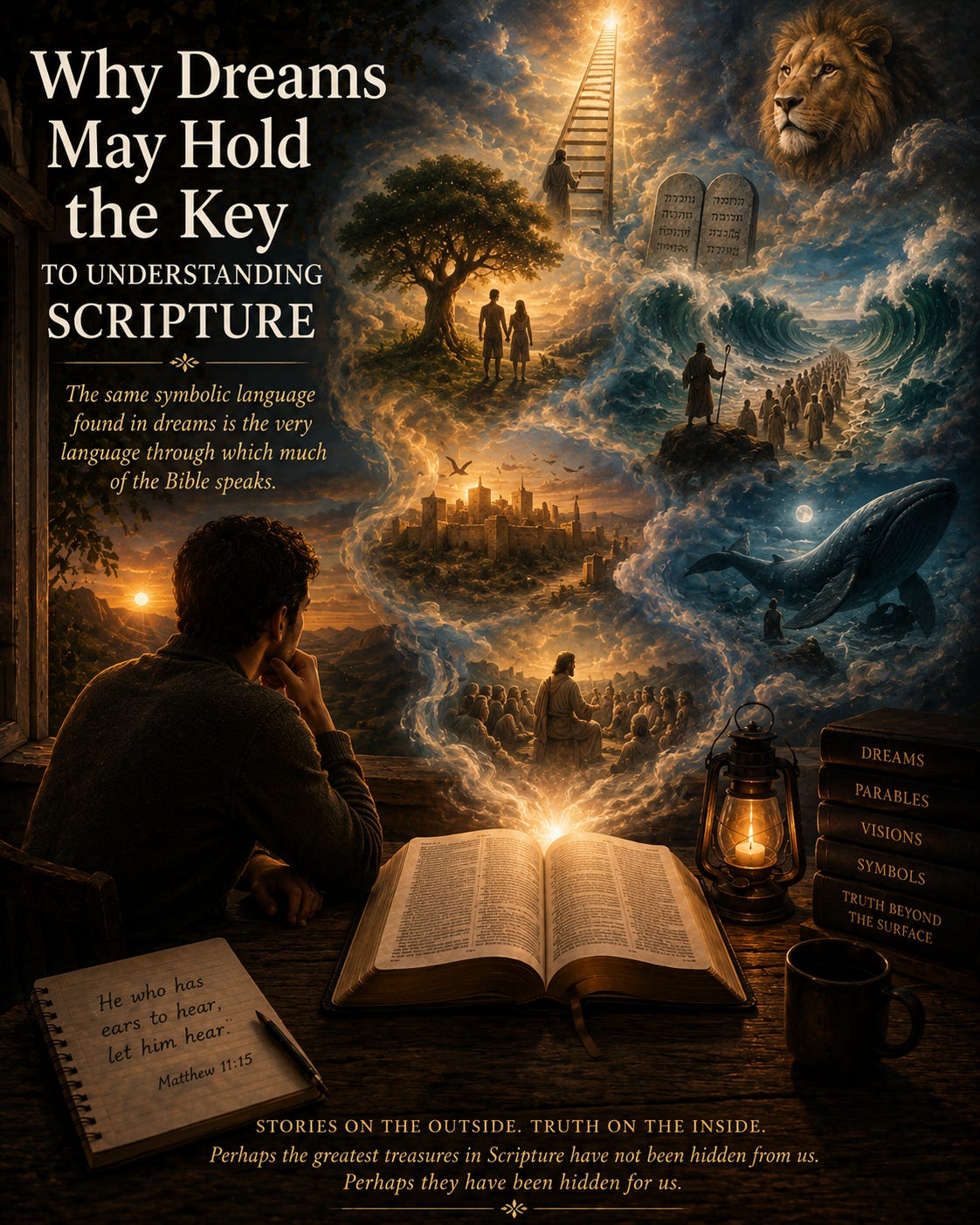
What if the same symbolic language found in dreams is the very language through which much of the Bible speaks?
At first, that may sound like a strange question.
For most of my life, I thought of dreams as something interesting, sometimes mysterious, but largely separate from the Bible itself. Yet the more I studied both, the more I began to wonder if they shared something in common.
Neither speaks primarily through facts and formulas.
When we dream, we rarely interpret everything literally. A house may represent our inner life. A journey may symbolize growth. Water may point to cleansing or emotions. Mountains may signify obstacles or higher understanding. Even the people we encounter may represent aspects of ourselves.
Dreams communicate through pictures.
Perhaps Scripture does as well.
This idea is hardly new. In fact, much of the Bible itself unfolds through dreams, visions, parables, and symbols.
Joseph interpreted dreams.
Daniel interpreted dreams and visions.
Jacob saw a ladder reaching to heaven.
Ezekiel saw wheels within wheels.
Jesus taught almost entirely through stories and parables and very little literally.
And the book of Revelation is filled with symbolic imagery that has fascinated readers for nearly two thousand years. The title of the book actually means more about revealing than about the end times.
Perhaps God has always spoken in this language.
Even Jesus often seemed frustrated when His listeners interpreted everything literally.
When He spoke of being “born again,” Nicodemus thought of physical birth.
When He spoke of the “bread of life,” many thought only of food.
When He spoke of the Kingdom of God, many expected an earthly kingdom.
Again and again, Jesus appeared to be pointing beyond the visible to something deeper.
Could it be that we have inherited the habit of reading literally what was intended to be understood symbolically?
When I began paying attention to dreams, I discovered something surprising. Dreams often tell stories that reveal truths about our fears, desires, relationships, struggles, and spiritual growth.
They speak in pictures because pictures bypass the analytical mind and touch something deeper.
Perhaps Scripture was designed to do the same.
Perhaps Egypt represents more than a geographical location.
Perhaps Pharaoh represents more than an ancient ruler.
Perhaps the wilderness represents those seasons when we feel lost.
Perhaps crossing the Jordan represents entering a new stage of life.
Perhaps Jerusalem itself points beyond a physical city to a state of consciousness characterized by peace and union with God.
None of this requires us to deny history.
But it may invite us to discover meanings that history alone cannot contain.
After all, facts belong to a particular moment in time.
Symbols speak to every generation.
And perhaps that is why these ancient stories continue to move us after thousands of years.
Maybe they are not merely stories about other people.
Maybe they are stories about us.
Perhaps that is what Jesus meant when He said:
“He who has ears to hear, let him hear.”
In the articles ahead, we will begin exploring familiar stories with fresh eyes.
And we will start where all human stories begin.
In a garden.
Coming Next
Adam and Eve: The Birth of Self-Consciousness
What if the story of Eden is not merely about two people long ago, but about the awakening of human consciousness itself?