


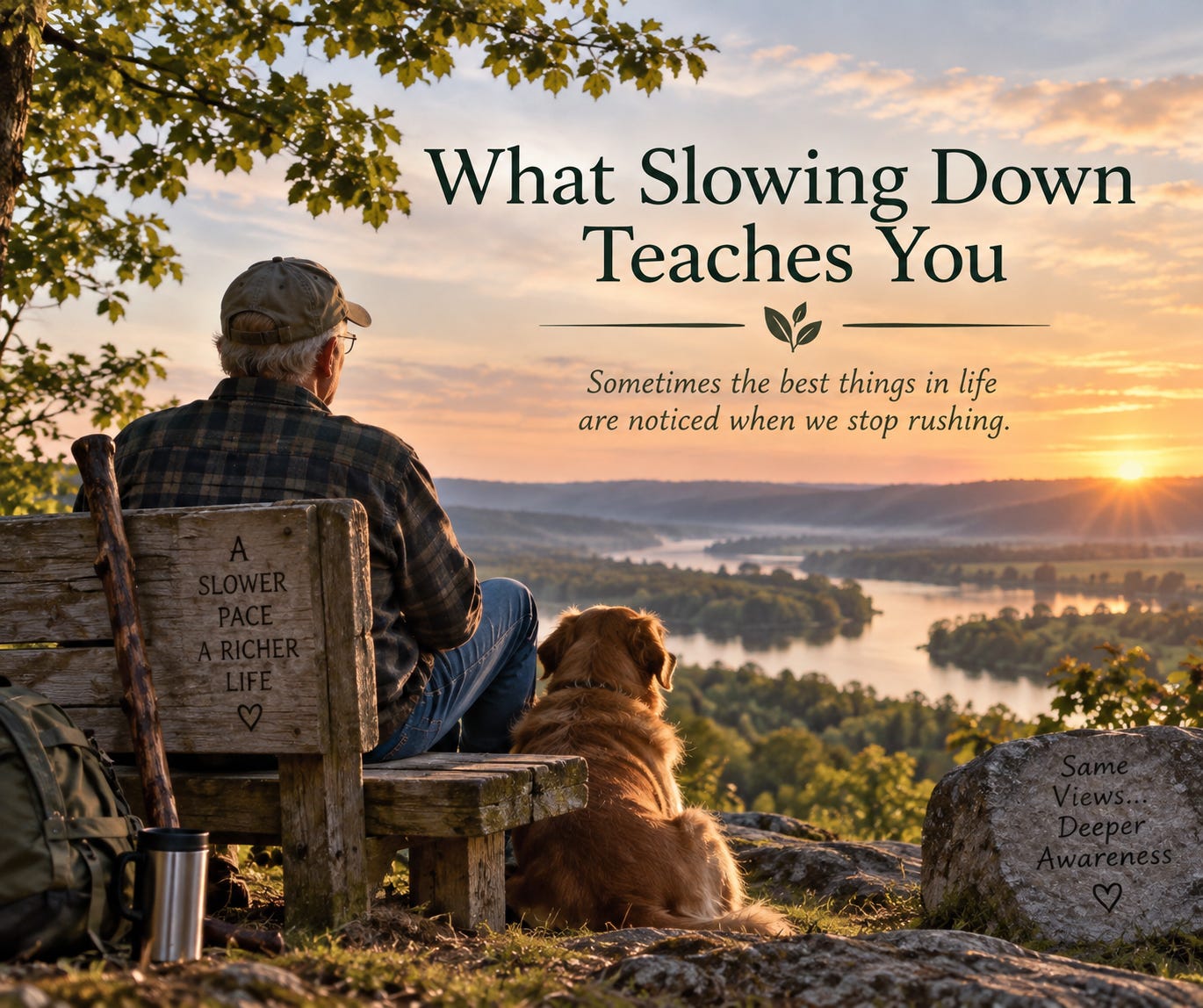
Much of life is spent moving forward at a pace we rarely question. Work, responsibility, and routine keep us in motion, often leaving very little room to notice what that speed costs us in the long run. Slowing down usually isn’t something we plan for — it arrives through age, change, or circumstance — and when it does, it brings lessons we don’t always expect.
This reflection is about what reveals itself when life lessons loosen their grip a little, and what becomes clearer when time is no longer the taskmaster.
Slowing down isn’t something most people choose, especially for someone very active. It usually arrives on its own schedule. Sometimes it comes from age, sometimes from health, sometimes from circumstances that simply change the pace of life — whether you’re ready or not.
For most of my life, slowing down was not an option. There was always work to do, places to be, responsibilities waiting. Being busy felt normal. In some ways, it felt necessary. Only later did I begin to understand that constant motion can hide things — especially the quieter lessons that only show up when life eases its grip a little, and you finally have time to think.
I’ve come to realize that slowing down brings a certain freedom. You’re no longer a slave to the clock. You can pick and choose what you want to do, rather than letting a schedule make those choices for you.
One of the first things slowing down teaches you is how hectic life really was — everything moving in every direction at once. When the schedule thins out, you notice how much of your time used to be spent reacting instead of thinking. You begin to hear your own thoughts again and even pay attention to your dreams, which are often quiet indicators of what’s going on beneath the surface. Some are useful. Some are simply your mind organizing itself behind the scenes. Some memories are uncomfortable. But they’re yours, and you can’t work through them when everything is rushed.
Slowing down also changes how you see people. When you’re not racing the clock, you start noticing small things — a hesitation in someone’s voice, the way people repeat the same stories because those stories still matter to them. You become less interested in winning conversations and more interested in understanding them. Patience grows, not because you worked at it, but because speed is no longer driving the moment.
I’ve stood in checkout lines with impatient people dealing with a new cashier. Most folks are understanding, but there are always a few who make things harder than they need to be. I try to stay patient and not let my joy be dictated by circumstances. Life, in the long run, after al,l is but a vapor. Some people, it seems, are placed in our path to test our patience, and how we respond matters more than the situation itself. Everyone carries a story — difficult childhoods, broken marriages, loss, or simply a different way of being. I try not to judge, because you never really know.
You also begin to realize how much of what once felt urgent really wasn’t. Many problems resolved themselves. Others simply didn’t matter as much as you thought. You can’t — and probably shouldn’t — do everything you once did, at least not in the same way. I still enjoy building and repairing things, though that has slowed somewhat. With 85 acres and buildings to maintain, I still get my share. At first, slowing down feels like a loss. Over time, it feels more manageable.
You stop proving yourself. Approval from others matters less — your ego, hopefully, is under new management. You become more comfortable saying no, and life doesn’t fall apart when you do.
Slowing down teaches respect for time. When you’re younger, time feels endless. When the pace eases, you see it more clearly — not as something to fill, but something to use well. You become selective. You choose where your energy goes because you understand it isn’t renewable.
Perhaps the most important lesson is this: slowing down doesn’t mean stepping out of life. It means stepping into it differently. You’re still learning. Still contributing. Still caring. But now it’s done with intention rather than momentum. Taking care of your body becomes more important — eating right, exercising, and enjoying quiet moments. These things help make slowing down more of a choice than a mandate.
In a culture that celebrates speed, slowing down can feel like a flaw. In reality, it’s often a correction. It strips away what’s unnecessary and leaves behind what was always important.
And that, I’ve found, is a lesson worth arriving at — even if it takes most of a lifetime.
Another good one Warren. Bravo